Friday, June 15, 2012

THE TIME I TRIED TO EDIT RAY BRADBURY


     When a famous author dies, readers write fondly about the first time they met the icon -- in print, that is -- and let us know which book or quote is their favorite. Friends of the dearly departed, who knew the writer beyond his or her written work, pen more personal tributes. Then there are us lesser lights who recall our brief brush with greatness -- and cringe at the memory.

       Like the time I tried to edit Ray Bradbury.

       My close encounter with Bradbury was a disaster. And as I look back now, a pretty predictable disaster. There I was a lowly book editor at the St. Petersburg Times asking a sci-fi megastar to do a piece on assignment, an article imagining how the Super Bowl might evolve in 100 years. What chutzpah!

      At first, my charming naivety paid off. Bradbury agreed to do the work  -- albeit for an exorbitant price. But charm and chutzpah ultimately couldn't save me from the inherent folly of the enterprise. When it was all over, Bradbury got to bank a hefty kill fee and I deposited three important conclusions:

       1) Imaginative writing should not be commissioned.
       2) Science fiction/fantasy writers are not overly fond of narrative structure.
       3) All writers need editors except the famous ones who won't.

       Like a lot of bad ideas, this idea sounded good at the time. It was just before the 35th Super Bowl in January 2001, the first Super Bowl of the 20th century, and it was to be held in Tampa. The newspaper's sports editor thought it would be cool to have a science fiction writer imagine what Super Bowl 2101 would look like.
     
       I could have found a local sci fi writer who would have been thrilled to take a stab it. But, no. I had to think BIG. I had to go for the supernova of sci fi/fantasy: Ray Bradbury.

      I should have been wary when Bradbury asked for so much money. But, hey, how can you put a price on greatness? What a coup a Bradbury original would be! People would be talking about this piece for decades -- maybe even until 2101.

     Then Bradbury's article arrived.

      He had entitled it Sporticus 2101. He imagined the greatest Super Bowl game in all history was held in a super arena that had been conceived in the year 2000 by the architectural consultant/designer Ray Bradbury. He imagined the humongous stadium was ringed with endless shops where athletes of every sport imaginable -- even jai alai -- could find the world's best sports equipment. He imagined that the first Superbowl of the 22nd century was witnessed by two billion people who paid one hundred billion dollars to see the Quicksilver Lites beat the Gigantic Bisons.

     All the ingredients were there. The only problem was, they were not there in any readable order. The piece was chaotic, with imaginative ideas popping out all over the place. It was nearly impossible to follow as Bradbury offered up sentence fragments and inexplicable twists and turns.

     The gigantic stadium and its environs had become the center of all sports in the U.S.: surfing, ski jumping, even kite-flying and fights between wild buffalos and stark mad elephants. The revenues from the Super Bowl were given to needy countries to build schools. Stadiums like Sporticus were built all over the world and eventually wiped out wars. The U.S. president once had been a star quarterback. Future football leagues had three weight divisions.

       Huh? What's he talking about? the sports editor asked me. Don't worry, I told him. It'll be fine.

       I'll just do some editing.

        I moved sentences around. I completed others. I tried to fill in some holes in Bradbury's logic. I smoothed over the bumps. When some of the sentences still remained unclear to me, I attached notes, asking Bradbury to clarify and/or to flush out certain sections.

       Okay, I gutted the piece. I tried to tame Bradbury's exuberance and create a more coherent narrative. I trimmed back excess and shaped the story into something less confusing albeit more prosaic. Then I emailed the edited version to Bradbury with a note about how it was such an honor to work with him. I tried to make it clear that this was just the beginning of the editing process. None of my changes were writ in stone. I imagined myself the Maxwell Perkins to his Ernest Hemingway.

      Bradbury was quick to respond: We had to print exactly what he wrote or nothing at all.

      We chose nothing. We sent him a kill fee of thousands of dollars. It seemed fair. He was, after all, Ray Bradbury.

      Over the years, I have mulled over and over this hapless story of my Distant Sighting of Ray Bradbury. At times, when I'm feeling pessimistic, I am convinced that he knew all along that we would never print his mishmash of a piece and that he just took the assignment for the kill fee. I imagine him laughing at our attempt to make the muddled article work for a newspaper audience. At other more self-deprecating times, I tell myself that it was all my fault. I was awfully cheeky to try to edit such an icon and I deserved to be turned flat down. I imagine that Bradbury was sad not to see his phantasmagoric imaginings of Super Bowl 2101 in print.

      Then I remember: I am talking about Ray Bradbury, a writer who authored hundreds of published short stories, close to 50 books and numerous poems, essays, operas, plays, teleplays and screenplays during a career that lasted more than 70 years. We clearly had needed him far more than he had needed us. Why should he have bothered to deal with an obscure book editor?

       Bradbury already had legions of adoring fans who wouldn't have cared a whit that his piece read like a first draft. Sci fi lovers are notoriously tolerant of works that show their seams in the service of an imaginative idea. Why else would fans of Doctor Who have put up with those cheesy props and fake planets for so long?

     In her tribute to Bradbury on her blog Ramblings, my niece Sonja  explained why she was willing to accept the implausibility of matters both large and small in her reading and later re-reading of a Bradbury's short story entitled "All Summer in a Day."

    She was in the sixth grade when the teacher had the class read that story of an Earth girl who was tormented by her classmates on Venus. It was Sonja's first introduction to Bradbury. She was entranced with the idea of a world where the sun only came out for two hours every seven years. Then as an adult and a teacher herself, she assigned "All Summer in a Day" to her students. On re-reading the tale, Sonja noticed a few off-kilter details she had overlooked as a child. But so what? What's a plot hole or two matter in a story that has haunted you for years? Bradbury already had her believing that a girl could travel from Earth to Venus and that a planet could sustain life without sunshine. Having to swallow more minor imaginative stretchings -- like why would the teacher have left her students alone and why when they went out to see the sun wouldn't she have noticed a pupil was missing -- was no biggie in the service of making a point about bullying in such a unique way. "'All Summer in a Day' was an excellent way to open a deeper discussion with students about tolerating differences among classmates," my niece wrote, opting for originality over believability.

       Of course, Bradbury's forecast of a super Super Bowl stadium wasn't all that damn original. Decades earlier -- in Esquire in 1973 -- William Harrison had already conjured up a future sports arena that was awesome to behold. Rollerball, anyone? But Bradbury's imaginings of the first Super Bowl of the 21st century had come in a vintage Bradbury package that his more devoted fans might have appreciated. As far removed from the who-what-when-where-why-how inverted pyramid structure of journalism as you could get, Sporticus 2101 was a jumbled juxtaposition of crazy flights of fancy, loopy predictions and prosaic declarations coming at you in a feverish, confusing flood of Bradbury words.

       Every last unedited one of them.


Friday, June 8, 2012

HOW TO LIVE FOREVER (RESULTS MAY VARY)

Several years ago I got a call from Mark Wexler. We used to refer to a call like that as a blast from the past. I hadn't talked with Mark since we both lived in New York in the Eighties. Back then, he was a photographer. Since then he had become a documentary filmmaker. He had already completed two films: "Me and My Matchmaker" and "Tell Them Who You Are." The latter is about his famous father, cinematographer Haskell Wexler. I had never known he was that Wexler's son.


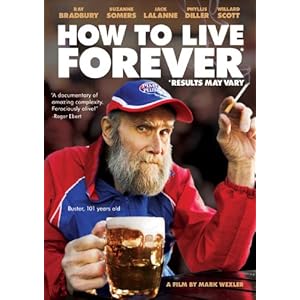
Mark invited me to meet him at the Sarasota Film Festival to see his latest documentary, "How to Live Forever."  It's all about the fears (and joys) of growing old, which dovetails nicely with my creative late bloomer obsessions.


How to Live ForeverThe film is told in a wry and really engaging way. You don't expect to laugh when you go to a film about aging, but this one's a riot. Its cast of characters include the world's oldest woman, Phyllis Diller, a 94-year-old heart surgeon, Jack Lalane, a 92-year-old Japanese who dives for fish, Suzanne Somers who is touting hormones, a coffin maker and the people of Okinawa who are the longest living on earth.


After seeing the film, I told Mark, "Everyone should see this film -- young and old." Now everyone can. It's finally available as a DVD on Amazon and iTunes. The DVD has 30 minutes of bonus material that I probably didn't see when I was down in Sarasota. Now I'll have to buy the DVD, too. Pretty clever of you, Mark.


The release of the "How to Live Forever" DVD coincidentally comes in the same week as the death of Ray Bradbury who is one of the subjects in Mark's film. Of course, Bradbury, who was 91 when he died on June 5, long ago found a way to live forever: through his books.


In the film, Bradbury, who was then 87, points out that he has written many books about old people, referring in particular to "Dandelion Wine," published in 1957. Then he talks about the sequel he just has written to that book which he says is again about the relationship between younger and older folk. This time though, he says, it's a conversation between his 13-year-old self and his older self. He compares the confrontation of these two Bradburys to Lee and Grant at Appomattox. Each has to learn to accept the other, he says. He doesn't name the book, but it turned out to be the last novel he released in his lifetime, published in 2006. It's called "Farewell Summer."


Tuesday, June 5, 2012

TRAVELING NEVER GETS OLD -- AND NEITHER DOES THE TRAVEL MEMOIR. JUST ASK OPRAH.


      Do you have enough travel stories to fill a book? Do you want your grandchildren and great-grandchildren to see the world through your eyes? Do you dream of getting paid to travel? If you said yes to any of these questions, you may be the victim of a highly contagious disease known as the travel writing bug. Don’t be alarmed. There is a cure. Write a travel memoir. 
     People have been travel writing for millennia, beginning with those who recorded their adventures on cave walls. Some merely wrote essays on “What I Did on My Summer Vacation.” Others described deeply spiritual quests... 


    That is beginning of my description of the Travel Memoir class I am offering June 6 on the campus of Eckerd College. It's my first OLLI class.


      OLLI stands for Osher Lifelong Learning Institute. The concept of OLLI is simple: Curiosity never retires. OLLI, which exists on campuses across the country, is a membership organization that offers learning opportunities to midlife and older adults (50 and older, that is). Members pay a small annual fee and then can attend a whole slew of lectures, go on dozens of educational excursions and form special interest groups, all for very reasonable prices. 
     
      In my course description,  I cite two memoirs that have been huge bestsellers: Peter Mayle's A Year in Provence and Elizabeth Gilbert's Eat, Pray, Love. Breezy reads, they are not, I admit, the most adventurous examples of the genre. But wouldn't the bandits, dervishes and idol worshippers in more grittier memoirs, such as Freya Stark's The Valley of the Assassins, have scared people away?
      
        No, it turns out. According to an informal survey I made on Facebook and Twitter, in preparation for the class, the grittier, the better. At least that was the case for those who answered my post, "What Is Your Favorite Travel Memoir?"


       No one who responded even mentioned Eat, Pray, Love. Mindi Dickstein, a lyricist and a librettist who teaches musical theater at New York University, did single out A Year in Provence, but she clearly was far more excited about her other two picks: Bruce Chatwin's The Songlines and David Rieff's Going to Miami (the latter, which details its own version of bandits, dervishes and idol worshippers in Florida, has been called an "anti-traveloque"). She just wasn't certain they qualified as travel memoirs. 

      She needn't have worried. The genre covers a lot of territory. 
    
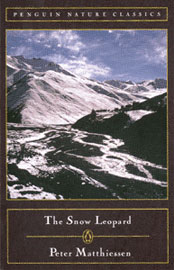
      The titles my social networking friends suggested, in fact, were quite literally all over the map. Susan Farewell, editor-in-chief of FarewellTravels.com, suggested Lawrence Durrell's Bitter Lemons ("really a memoir of Cyprus") as well as Durrell's Spirit of Place: Letters and Essays on Travel. An American expat living in Singapore who tweets @chamorro_chica and blogs at chamorrochica.com offered up Machu My Picchu by Iris Bahr. Barbara Kagan, a graphic designer at Southern Connecticut State University, chose Tony Horwitz's Baghdad Without a Map and Other Misadventures in Arabia. Janet Krietemeyer Keeler, a travel and food editor, confessed her preferences were Nothing to Declare by Mary Morris and Shopping for Buddhas by Jeff Greenwald while her colleague at Tampa Bay Times, Florida culture writer Jeff Klinkenberg, gave a nod to both Bruce Chatwin's In Patagonia and Peter Matthiessen's The Snow Leopard. Everett Potter, publisher of Everett Potter's Travel Report, also tweeted The Snow Leopard as his fav to which travel editor Veronica Stoddart at USA Today replied, "Ditto."


     Minnesota Star Tribune's Laurie Hertzel gave a shout out to all of Eric Newby's books, particularly A Short Walk in the Hindu Kush. Book critic Carole Goldberg (formerly at the Hartford Courant) chose Revolution: The Year I Fell in Love and Went to Join the War by Deb Olin Unferth. One-Minute Book Reviews Jan Harayda recommended A House Somewhere: Tales of Life Abroad, "a collection of 26 essays by (mostly) well known travel writers or journalists on their favorite places," including Tim Parks, Simon Winchester and Frances Mayes. Former National Book Critics Circle president Jane Ciabattari picked On Persephone's Island: A Sicilian Journal by Mary Taylor Smith: "I've reread it many times. Great one!"


       Someone directed me to the London Telegraph's recent list of "20 best travel books of all time." Surprisingly, it includes seven novels: Jack Kerouac's On the Road, Alex Garland's The Beach, Jan Morris' Venice, Ernest Hemingway's The Sun Also Rises, Arundhati Roy's The God of Small Things, Hunter S. Thompson's Fear and Loathing in Las Vegas, and Graham Greene's Our Man in Havana. 


     Can a travel memoir be fiction? I usually think of a memoir as a work of non-fiction, but all of those novels do combine a fierce sense of place with intense personal reflection, a good definition of a travel memoir, I think. Often a sense of place so dominates a fictional narrative that it does feel like a travel memoir. When I go to Paris, for example, I like to bring along the latest mystery by Cara Black. Starring Aimee Leduc, a half American, half French detective, Black's mysteries are set in various quartiers across the City of Lights (Murder in the Marais, Murder in the Latin Quarter) and are chock-a-block with interesting facts and reflections about those neighborhoods. The Venice-based mysteries of Donna Leon (Death at La Fenice) are like that, too.

     Natch, Black answered my question, "What Is Your Favorite Travel Memoir," with a French-drenched title of non-fiction: Almost French by Alexandra Turnbull. An Australian journalist, Turnbull only meant to stay a week in Paris when she agreed to meet her lover there in the mid-1990s. She ended up calling it home. 


       And speaking of home, can a book describing a city where the author grew up still be considered a "travel" memoir?  That latter question was posed by Gina Vivinetto, who teaches creative writing at the University of Tampa. She was thinking of Orhan Pamuk's novel Istanbul.


        Yes, I say, yes! Istanbul is a perfect example of the double nature of the travel memoir as both exterior and interior journey. Pamuk shows us the city that is around him and within him. For me, travel memoirs capture the spirit of a particular time and place but also the transformation of the person who is doing the observing of that time and place. Ultimately, they are descriptions of personal journeys. And what could be more personal a journey than the one taken to discover the place of one's very roots?


       Tame. Gritty. Fiction. Non-fiction. Home. Away from home. So what from all these examples can we conclude makes for a good travel memoir?  
    
       Clearly, the best examples of the genre work on several levels at once. Take The Snow Leopard, the most frequently mentioned title for fav travel memoir in my Facebook and Twitter survey.  In The Snow Leopard, published nearly 40 decades ago, Peter Matthiessen describes a hike he took in the fall of 1973 that took him 250 miles into the heart of the Himalayan region of Dolpo, "the last enclave of pure Tibetan culture on earth." His journey with zoologist George Schaller is purportedly about tracking down the elusive big cat of the title, but through the eyes and pen of Matthiessen, the trip becomes a spiritual quest, a search for nothing short of the meaning of life itself.
     
     Very Buddhist, just like its author.

     Which brings me to Oprah. Oprah, alas, is not one of my Facebook friends or Twitter followers, but in the midst of my researching this topic, she inadvertently answered my question, What Is Your Favorite Travel Memoir?, by choosing one as her first Book Club 2.0 pick:
Wild: From Lost to Found on the Pacific Crest Trail (Oprah's Book Club 2.0)


        Wild: From Lost to Found on the Pacific Crest Trail by Cheryl Strayed. 


        The author of this book has the perfect name for a travel writer. And that's no accident.  In 1995 the author of Wild legally changed her name to Cheryl Strayed, a moniker she chose herself. I was unable to find out what her original name had been, but the change certainly reflects the theme of self-affirmation that has made her memoir a bestseller (and, most likely, is what so attracted Oprah to it).


      Like Matthiessen, Strayed's hike was arduous and challenging. But, again like Matthiessen's lyrical ruminations in The Snow Leopard,  the real story Strayed tells us in Wild is not about the rattlesnakes and black bears, the searing heat and freezing temperatures nor the stunning views and interesting people she meets up with on her 1100-mile solo trek. It's about the inward journey she takes. It's about her discovery of that Buddhist of Buddhist truisms used by Jon Kabut-Zinn for the title of his book on the mindfullness of meditation: "No matter where you go, there you are."
  
       It is what lies at the heart of every great travel memoir and it is why we love to read them. 


       "To awaken quite alone in a strange town is one of the pleasantest sensations in the world," writes Creative Late Bloomer Freya Stark in Baghdad Sketches, one of 30 travel books the intrepid British traveller wrote from age 42 until her death at age 100.  "You have no idea what is in store for you, but you will, if you are wise and know the art of travel, let yourself go on the stream of the unknown and accept whatever comes in the spirit in which the gods may offer it. For this reason your customary thoughts, all except the rarest of your friends, even most of your luggage -- everything, in fact, which belongs to your everyday life, is merely a hindrance. The tourist travels in his own atmosphere like a snail in his shell and stands, as it were, on his own perambulating doorstep to look at the continents of the world. But if you discard all this, and sally forth with a leisurely and blank mind, there is no knowing what may not happen to you."