Tuesday, June 5, 2012

TRAVELING NEVER GETS OLD -- AND NEITHER DOES THE TRAVEL MEMOIR. JUST ASK OPRAH.


      Do you have enough travel stories to fill a book? Do you want your grandchildren and great-grandchildren to see the world through your eyes? Do you dream of getting paid to travel? If you said yes to any of these questions, you may be the victim of a highly contagious disease known as the travel writing bug. Don’t be alarmed. There is a cure. Write a travel memoir. 
     People have been travel writing for millennia, beginning with those who recorded their adventures on cave walls. Some merely wrote essays on “What I Did on My Summer Vacation.” Others described deeply spiritual quests... 


    That is beginning of my description of the Travel Memoir class I am offering June 6 on the campus of Eckerd College. It's my first OLLI class.


      OLLI stands for Osher Lifelong Learning Institute. The concept of OLLI is simple: Curiosity never retires. OLLI, which exists on campuses across the country, is a membership organization that offers learning opportunities to midlife and older adults (50 and older, that is). Members pay a small annual fee and then can attend a whole slew of lectures, go on dozens of educational excursions and form special interest groups, all for very reasonable prices. 
     
      In my course description,  I cite two memoirs that have been huge bestsellers: Peter Mayle's A Year in Provence and Elizabeth Gilbert's Eat, Pray, Love. Breezy reads, they are not, I admit, the most adventurous examples of the genre. But wouldn't the bandits, dervishes and idol worshippers in more grittier memoirs, such as Freya Stark's The Valley of the Assassins, have scared people away?
      
        No, it turns out. According to an informal survey I made on Facebook and Twitter, in preparation for the class, the grittier, the better. At least that was the case for those who answered my post, "What Is Your Favorite Travel Memoir?"


       No one who responded even mentioned Eat, Pray, Love. Mindi Dickstein, a lyricist and a librettist who teaches musical theater at New York University, did single out A Year in Provence, but she clearly was far more excited about her other two picks: Bruce Chatwin's The Songlines and David Rieff's Going to Miami (the latter, which details its own version of bandits, dervishes and idol worshippers in Florida, has been called an "anti-traveloque"). She just wasn't certain they qualified as travel memoirs. 

      She needn't have worried. The genre covers a lot of territory. 
    
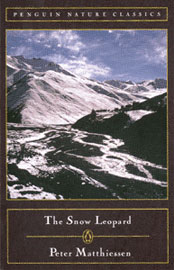
      The titles my social networking friends suggested, in fact, were quite literally all over the map. Susan Farewell, editor-in-chief of FarewellTravels.com, suggested Lawrence Durrell's Bitter Lemons ("really a memoir of Cyprus") as well as Durrell's Spirit of Place: Letters and Essays on Travel. An American expat living in Singapore who tweets @chamorro_chica and blogs at chamorrochica.com offered up Machu My Picchu by Iris Bahr. Barbara Kagan, a graphic designer at Southern Connecticut State University, chose Tony Horwitz's Baghdad Without a Map and Other Misadventures in ArabiaJanet Krietemeyer Keeler, a travel and food editor, confessed her preferences were Nothing to Declare by Mary Morris and Shopping for Buddhas by Jeff Greenwald while her colleague at Tampa Bay Times, Florida culture writer Jeff Klinkenberg, gave a nod to both Bruce Chatwin's In Patagonia and Peter Matthiessen's The Snow Leopard. Everett Potter, publisher of Everett Potter's Travel Report, also tweeted The Snow Leopard as his fav to which travel editor Veronica Stoddart at USA Today replied, "Ditto."


     Minnesota Star Tribune's Laurie Hertzel gave a shout out to all of Eric Newby's books, particularly A Short Walk in the Hindu Kush. Book critic Carole Goldberg (formerly at the Hartford Courant) chose Revolution: The Year I Fell in Love and Went to Join the War by Deb Olin Unferth. One-Minute Book Reviews Jan Harayda recommended A House Somewhere: Tales of Life Abroad, "a collection of 26 essays by (mostly) well known travel writers or journalists on their favorite places," including Tim Parks, Simon Winchester and Frances Mayes. Former National Book Critics Circle president Jane Ciabattari picked On Persephone's Island: A Sicilian Journal by Mary Taylor Smith: "I've reread it many times. Great one!"


       Someone directed me to the London Telegraph's recent list of "20 best travel books of all time." Surprisingly, it includes seven novels: Jack Kerouac's On the Road, Alex Garland's The Beach, Jan Morris' Venice, Ernest Hemingway's The Sun Also Rises, Arundhati Roy's The God of Small Things, Hunter S. Thompson's Fear and Loathing in Las Vegas, and Graham Greene's Our Man in Havana


     Can a travel memoir be fiction? I usually think of a memoir as a work of non-fiction, but all of those novels do combine a fierce sense of place with intense personal reflection, a good definition of a travel memoir, I think. Often a sense of place so dominates a fictional narrative that it does feel like a travel memoir. When I go to Paris, for example, I like to bring along the latest mystery by Cara Black. Starring Aimee Leduc, a half American, half French detective, Black's mysteries are set in various quartiers across the City of Lights (Murder in the Marais, Murder in the Latin Quarter) and are chock-a-block with interesting facts and reflections about those neighborhoods. The Venice-based mysteries of Donna Leon (Death at La Fenice) are like that, too.

     Natch, Black answered my question, "What Is Your Favorite Travel Memoir," with a French-drenched title of non-fiction: Almost French by Alexandra Turnbull. An Australian journalist, Turnbull only meant to stay a week in Paris when she agreed to meet her lover there in the mid-1990s. She ended up calling it home. 


       And speaking of home, can a book describing a city where the author grew up still be considered a "travel" memoir?  That latter question was posed by Gina Vivinetto, who teaches creative writing at the University of Tampa. She was thinking of Orhan Pamuk's novel Istanbul.

        Yes, I say, yes! Istanbul is a perfect example of the double nature of the travel memoir as both exterior and interior journey. Pamuk shows us the city that is around him and within him. For me, travel memoirs capture the spirit of a particular time and place but also the transformation of the person who is doing the observing of that time and place. Ultimately, they are descriptions of personal journeys. And what could be more personal a journey than the one taken to discover the place of one's very roots?


       Tame. Gritty. Fiction. Non-fiction. Home. Away from home. So what from all these examples can we conclude makes for a good travel memoir?  
    
       Clearly, the best examples of the genre work on several levels at once. Take The Snow Leopard, the most frequently mentioned title for fav travel memoir in my Facebook and Twitter survey.  In The Snow Leopard, published nearly 40 decades ago, Peter Matthiessen describes a hike he took in the fall of 1973 that took him 250 miles into the heart of the Himalayan region of Dolpo, "the last enclave of pure Tibetan culture on earth." His journey with zoologist George Schaller is purportedly about tracking down the elusive big cat of the title, but through the eyes and pen of Matthiessen, the trip becomes a spiritual quest, a search for nothing short of the meaning of life itself.
     
     Very Buddhist, just like its author.

     Which brings me to Oprah. Oprah, alas, is not one of my Facebook friends or Twitter followers, but in the midst of my researching this topic, she inadvertently answered my question, What Is Your Favorite Travel Memoir?, by choosing one as her first Book Club 2.0 pick:
Wild: From Lost to Found on the Pacific Crest Trail (Oprah's Book Club 2.0)


        Wild: From Lost to Found on the Pacific Crest Trail by Cheryl Strayed. 


        The author of this book has the perfect name for a travel writer. And that's no accident.  In 1995 the author of Wild legally changed her name to Cheryl Strayed, a moniker she chose herself. I was unable to find out what her original name had been, but the change certainly reflects the theme of self-affirmation that has made her memoir a bestseller (and, most likely, is what so attracted Oprah to it).


      Like Matthiessen, Strayed's hike was arduous and challenging. But, again like Matthiessen's lyrical ruminations in The Snow Leopard,  the real story Strayed tells us in Wild is not about the rattlesnakes and black bears, the searing heat and freezing temperatures nor the stunning views and interesting people she meets up with on her 1100-mile solo trek. It's about the inward journey she takes. It's about her discovery of that Buddhist of Buddhist truisms used by Jon Kabut-Zinn for the title of his book on the mindfullness of meditation: "No matter where you go, there you are."
  
       It is what lies at the heart of every great travel memoir and it is why we love to read them. 


       "To awaken quite alone in a strange town is one of the pleasantest sensations in the world," writes Creative Late Bloomer Freya Stark in Baghdad Sketches, one of 30 travel books the intrepid British traveller wrote from age 42 until her death at age 100.  "You have no idea what is in store for you, but you will, if you are wise and know the art of travel, let yourself go on the stream of the unknown and accept whatever comes in the spirit in which the gods may offer it. For this reason your customary thoughts, all except the rarest of your friends, even most of your luggage -- everything, in fact, which belongs to your everyday life, is merely a hindrance. The tourist travels in his own atmosphere like a snail in his shell and stands, as it were, on his own perambulating doorstep to look at the continents of the world. But if you discard all this, and sally forth with a leisurely and blank mind, there is no knowing what may not happen to you."




Wednesday, May 16, 2012

DO I HAVE TO LIKE LAURA INGALLS WILDER TO APPRECIATE HER ACHIEVEMENT?


Can you dislike an artist and still appreciate his or her accomplishments? If people you do not admire draw different -- and, to you, objectionable -- conclusions from the work of an author, does that change your own view of that work and/or the artist who produced it? Can you applaud the poems of Ezra Pound knowing he was a Fascist? Can you appreciate Wagner after discovering he was a favorite of the Nazis? 
     Does the racial attitudes toward Indians in the "Little House" books diminish your admiration for their author, Laura Ingalls Wilder, who wrote the stories of her pioneer childhood when she was in her sixties? Does the fact that those books now are embraced by "kooky survivalists" and Tea Party members like Sarah Palin change your view them?
      Reading Wendy McClure's hilarious and generous account of her childhood -- and adult -- obsession with Laura Wilder Ingalls and her "Little House" series helped me answer those questions.
      In "The Wilder Life: My Adventures in the Lost World of Little House on the Prairie" (Riverhead Books). McClure goes in search of Laura Ingalls Wilder, the 13-year-old heroine of the "Little House" series. That's the children's book classic that inevitably is described with the word "beloved" attached. McClure's Laura dresses in calico, lives in a little house on the prairie and celebrates the virtues of independence and female pluckiness. 
       But while trying to track down the sun-bonneted fictional Laura, McClure keeps butting up against another Laura: the flesh-and-blood adult author of the "Little House" series with whom she increasingly feels a creepy cultural divide. 
        Born in 1867 in the "Big Woods" of Wisconsin, that Laura, who more than a half a century later wrote down the stories of her family's pioneer lifedied in 1957, three days after her 90th birthday.
         The other Laura also was born in 1867 in the "Big Woods" of Wisconsin, but like all fictional characters, she is not an exact replica of her adult creator. For one thing, she lives on in the minds of readers like Wendy McClure.
      
                                              * * *

     I  never read the "Little House" books as a child, despite the fact that I was born in Wisconsin, only a few miles from where the tales begin. I only became interested in its author, Laura Ingalls Wilder when I was in my late fifties and began collecting stories of creative late bloomers. I latched on to the fact that Wilder was 65 when she published the series. Sixty-five! Her late-in-life success will give fifty-somethings and above hope, I thought. There's still time!
     I happily put Wilder on my list of creative late bloomers, but I didn't know much about her or how she came to write that phenomenally popular series in the voice of a 13-year-old. I did read how her daughter Rose, an editor and writer herself, had encouraged her mother to write down those childhood memories. That story made me identify with the Wilders even more. I had done the same with my mother – when she was in her eighties -- and even published – posthumously – a collection of my mom's essays entitled “Post Scripts: A Writing Life After 80.”
      I seemed to have a lot in common with these Wilder women, I thought.
Picture
Photo by Springfield News and Leader/Betty Love
      But as I delved deeper into the background of Laura Ingalls Wilder for a book I’m writing on creative late bloomers, I started to wonder if I even would have liked Laura Ingalls Wilder and her daughter if I had had a chance to meet them.
                          * * *


     McClure was never really interested in the late-blooming adult author of the "Little House" books. Her fierce identification was with that other Laura: the 13-year-old girl who described in such minute detail what what life was like when Indians didn't yet all live on reservations and pioneers built log cabins on the prairies.
          For a long time McClure thought she was Laura. Like many children who read the beloved series (didn't I tell you?), McClure had lived right alongside that 13-year-old on the prairie.  The books "gave me the uncanny sense that I'd experienced everything she had, that I had nearly drowned in the same flooded creek, endured the grasshopper plague of 1875, and lived through the Hard Winter," she writes in “The Wilder Life.”

Wendy McClure, author of "The Wilder Life"
   Those feelings of being inhabited by Laura persisted even into adulthood for McClure:. "No doubt it helped that countless family restaurants and steak emporiums of my 1970s suburban childhood went for rustic, antique-strewn decorating themes, with knickknack shelves full of tin cups and assorted old-timey crap. It didn't take much more than, say, the sight of a dusty glass oil lamp on the wall above a booth at a suburban Bonanza to make me feel like I was communing with Laura while I ate my cottage fries. Which I preferred to think of as 'pan-fired potatoes.'"
     In order to sort all this out, McClure decides to go in search of Laura and try to pin down why the "Little House" series had so enchanted her as a child.
    First, she re-reads the entire series. While the magic  – “the bears, the fiddle, the roasted pig’s tail! – returns, some disturbing elements crop up along with the enchantment. McClure, for example, is appalled by Laura and her family's questionable attitudes toward Indians on display in the books (Laura at one point refers to an Indian baby as “it”). Although she had always told herself that the family's uneasiness with the Indians was the point of the books, she now finds that baggage harder to take. 
     Pressing on, McClure reads biographies and scholarly books about Wilder -- over two dozens have been published in the past 40 years, from pictures books to a Marxist feminist critique -- and begins to separate fact from fiction. She reads that Laura couldn't possibly have recalled the details of the family's time on the Kansas prairie -- she wasn't even three years old -- and that the Ingalls family were not as innocent as the books portray them. They knew, for example, that they were building an illegal homestead on Osage land. She also learns why one of the places where the family moved is left out of the series altogether: The family had hightailed it out of Burr Oak, Iowa  to avoid paying rent. 
     The "Little House" books, she has to keep reminding herself,  are not an exact recording of real events, but historic fiction. Why let facts -- especially unpleasant ones -- get in the way of a good story?
    And then there is that infamous tension between Laura and her daughter Rose. Rose is credited with encouraging her mother to begin writing down the Ingalls family story. But just how much credit should Rose get for actually shaping the books?  Is she the real genius behind the classic? The biographies are divided into decidedly pro-Laura and pro-Rose camps.
     Who cares? McClure decides. The powerful sentiments that the books evoke in her are real enough whoever was responsible, she tells herself. She bakes bread from a Little House cookbook. She buys a butter churn. She visits the various locales (now museums) where Laura and her family lived in Wisconsin, Kansas, Minnesota, South Dakota. Missouri and, yes, even Burr Oak, Iowa. At the sites, she often finds herself surrounded by evangelicals who, she reflects grimly, share her love of Laura, "but maybe not my support for legalizing gay marriage." 
     At a "Homesteading Weekend" at the Clover Meadow Farm the lessons of self-reliance that she loves in the "Little House" series take on an even creepier political and religious tone. At the farm she meets up with members of a "kooky survivalist sect." The word "homesteading" means different things to different people, she concludes. All she wants to do is learn traditional skills like canning, blacksmithing and candle-making to recapture the adolescent simplicity of Laura’s world. They are preparing for the End Times.
     McClure begins to suspect that “if the adult Laura were alive today, there’d be something of a cultural divide between us.”
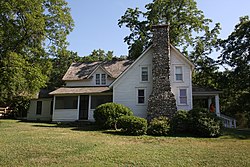
Rocky Ridge Farm where Laura Ingalls Wilder began to write.
    In my own research, I had been feeling that same gulf. Politically, both Laura and her daughter Rose seemed to have a lot in common with the modern Tea Party, a movement I find hard to admire because it so vehemently opposes helping those who can't help themselves. Both Laura and Rose were opposed to Franklin Roosevelt and his New Deal concern for the less fortunate. Rose called Roosevelt “a dictator” and wished him dead, Judith Thurman reports in a New Yorker article entitled "Wilder Women."  In “Credo,” a 1936 article in the Saturday Evening Post, Rose outlined her beliefs in "a quasi-anarchic democracy, with minimal taxes, limited government, and no entitlements, regulated only by the principle of personal responsibility." In 1943 Laura, a former Democrat who now blamed rural poverty on that party, told a Republican congressman that her family had made it "without help of any kind, from anyone."
     She was conveniently forgetting, of course, the help her pioneer family had received from the "federal government, which had cleared their land of its previous owners," Thurman points out. But, as McClure had discovered, Indians were not high on the list of Ingalls or Wilder concerns. In the "Little Hosue" series, Indians weren’t even accorded the status of people: "There were no people (on the prairie). Only Indians lived there" read one passage until, according to Wilder biographer Pamela Smith Hill, an outraged reader objected and Wilder agreed to amend the sentence. It now reads: "There were no settlers."
     Despite all her setbacks in her search for the innocent Laura, however, McClure pushes on. In the end, her book is a reminder of just how difficult it is to make sense of our childhood heroes and heroines, particularly the ones that only existed in our heads.  

                                                           * * *

       One of the McClure's stops in "The Wilder Life" is the comfortable farmhouse in Mansfield, Missouri, where Laura Ingalls Wilder actually wrote down her stories of the harsh life on the prairie more than 50 years after the fact. McClure admits that the Rocky Ridge Farm doesn't have the same allure for her as the other Laura Ingalls Wilder spots that she remembers described in the books. Still, at the farm, she is amazed to see so many artifacts on display that she recognizes directly from the books -- Pa's fiddle and the orange-covered notebooks that Laura Ingalls Wilder wrote down her stories in. All the biographies McClure had read had confirmed that, yes, she did buy those notebooks in the drugstore in town.
     "As a kid, I loved this detail; I myself had steno notebooks from Walgreen’s and wrote stories in them while lying across my bed on my stomach. Naturally I imagined her doing the same thing. Of course I didn’t quite get that she would have been in her sixties.”
     For me, it was just the opposite. I imagined a 60-something writer, a creative late bloomer finally re-living her past.
        I was inspired by Laura Ingalls Wilder’s late-in-life success.
        I still am.
        I don’t have to like a writer to admire her accomplishments.
       McClure taught me that. Creating a fictional character that generates such loyalty is no mean task at any age. But to recapture the magic of childhood – nearly 50 years later – is something of a miracle.
       Look, there she is, lying awake in bed listening to the world around her, trying to make some sense out of her life, just like every other teenager who ever existed:
      She was glad that the cozy house, and Pa and Ma and the firelight and the music, were now. They could not be forgotten, she thought, because now is now. It can never be a long time ago.


  •    


Saturday, May 12, 2012

SOLACE FOR MOTHERLESS DAY


       Mother's Day? I never became a mother and I don't have a mother anymore to whom I can send a card. So for me, Mother's Day has become just another day on the calendar, a holiday I can ignore.
       But when I got an email earlier this week from my high school boyfriend who told me that his mother had just died, I was reminded how painful that first motherless Mother's Day had been for me.
        My friend's email was not a particularly sad one. His mom had been sick and her death was not unexpected. He knew I had fond memories of his "somewhat boisterous parental units" and appreciated his mother's wicked wit, a trait he happily inherited. He knew I would appreciate his description of the Irish-like wake his family had held for her (after the funeral, they had placed a brandy and water and a flower at the head of the open bar in her honor). He wrote wistfully of his parents' last dance together at his daughter's wedding in October. He seemed okay.
      But I couldn't help but think how hard this Mother's Day was going to be for him.
      To send him some words of comfort, I dug out an article that I had written in 2005, six months after my mother had died. I was then working as the book editor at the St. Petersburg Times, so naturally, the piece is full of book references. I thought it would make him smile.
      In re-reading, I began to think that there may be others in need of comfort on their Motherless Day tomorrow. It will be my 7th. 

HEALING IN THE PAGES
By Margo Hammond

     Grief is an island. The isolated kind in the middle of a vast ocean where ships and crew are marooned and all communication is cut off. 

     Books can help.

     I learned that this year from personal experience. When my mother died in January, I found myself feeling suddenly thrown off course. It was as if some navigational point, some star by which I always had made my way through the world, had blinked off and I literally couldn't find my bearings. One evening, when friends invited me for dinner, I found myself driving aimlessly up and down streets in search of their house, a place that I used to find easily. Another day, while visiting another city, I took the bus along a familiar route and couldn't find my stop.
     
     I felt constantly dizzy. One day I came to work with two different shoes on - not just two different colors of the same type of shoe. Two entirely different shoes.


photo
My mom -- LaVerne Hammond (in blue) -- with fellow newspaper columnists (St. Petersburg Times photo)
     Intellectually I knew that, at 92, my mother had had a good run. She had led a long and fruitful life. But emotionally, I found myself mourning an 8-year-old writer. At age 84, my mother had published her first piece of writing, which eventually led to a monthly column in the St. Petersburg Times' Seniority section. I had helped her get started on this late-blooming career, one she had abandoned more than 60 years before to raise me and my three sisters. While she was in hospice, I had filed her last column on the morning of January 3. She died that night. The column was a letter that she had written to her first great-grandchild whom she knew she would never see grow up. Her writing career had lasted 8 years. 
      I felt I had lost not only a mother but a colleague.
     For solace, I turned to books. As a book editor, I knew there was a cottage industry of grief books. I had read Joan Didion's sensational The Year of Magical Thinking, which describes so achingly well the crazy state to which grief can drive someone. After my mother's death, I suddenly could relate, yet our griefs obviously were very different. She was grieving over the loss of a lifetime partner who had died suddenly. I was a middle-aged orphan.
     I looked for others' words that might cut closer to the bone of grief I was chewing on. The Grim Reader, an anthology offered by Maura Spiegel and Richard Tristman in 1997, included poems, essays and excerpts from fiction about death. Most of the entries, however, were rather general: Freud on transience; Brecht on his mortality; John Ashbery on the fear of death; Mark Twain on old age. Only Grace Paley's sudden recollection of her mother when she heard the song Oh, I Long to See My Mother in the Doorway on the radio seemed to apply to my case.
     In Katherine Ashenburg's The Mourner's Dance, published in 2002, I found a chapter that hit home. In "Sad Clothes," she noted how, in virtually every human society, mourners traditionally alter their physical appearance. They cut off their hair or leave it grow long. They don special clothing. "My poor sad face & garb must tell its tale," Queen Victoria said in 1864. Two different shoes?
     One book offered me practical advice. In 2005's Unattended Sorrow: Recovering from Loss and Reviving the Heart, Stephen Levine urged me to "soften the belly" where, he said, my grief, along with my fear, disappointment, anger and guilt, were stored. "The healing process is done by sitting quietly, closing your eyes and just letting your attention come into the sensations of the body. ... Soften the belly to unc
over the heart."
     One of the books I found was a moving and understated novel about loss called Grief. It is the story of a professor who tries to move on after the death of his mother in Florida for whom he was the prime caretaker. He goes to teach in Washington, D.C., where he struggles with the guilt of survival so common to his generation ravaged by AIDS but which in his case is compounded by the fact that he never told his mother that he was gay. The novel by Andrew Holleran explores people's ongoing need for intimacy, the loss of which we feel most acutely when we become orphans. "When your parents die, you know, your audience is gone," a friend tells the narrator, urging him to find a life partner. "But I think somebody has to care about you - someone has to think you matter."
     John Fanestil's Mrs. Hunter's Happy Death: Lessons on Living From People Preparing to Die was the odd choice I suppose, but it helped me make some sense of the last days of my mother's life. She spent them in a hospice unit surrounded by family and friends watching her die (she had been told her kidneys had failed her and there was nothing to be done). The woman Fanestil, a Methodist pastor, ruminates on, a 26-year-old who had died at the beginning of the 19th century, also had time to prepare for her death. The account of that preparation was recorded by a friend. Like my mother, Mrs. Hunter - her full name, Fanestil uncovered, was Mary Clulow Hunter - was a religious woman and her final journey was a spiritual one, not filled with fear but with hopeful expectation. "The kind of lives we lead help give shape to the deaths we die," Fanestil concluded, giving me new insight into those last moments with my mom, "and the kinds of deaths we seek help define the way we live."
     The two books that helped me most were given to me by others who had experienced grief. Perhaps it was the kindness behind the gift that gave them their potency. Or perhaps it was because the givers understood the strange land that is grief. At any rate, they both are like talismans that I return to again and again when the wave of grief returns.
     The first was from a psychiatrist friend who told me that the book had helped her after the death of her mother: How to Survive the Loss of a Parent: A Guide for Adults. Unlike the other books I had read, this one seemed aimed specifically at me: an adult who had lost a parent. Written by bereavement counselor Lois F. Akner, the book followed the experiences of a dozen clients who joined her six-week workshop. Although most of the mourners' situations differed greatly from mine, one overall theme emerged that helped me greatly: the loss of parent is like no other.
     The other was given to me by a colleague, someone I barely know, but who told me it had helped her when a close friend died. Each page of the book, A Time to Grieve: Meditations for Healing After the Death of a Loved One, by Carol Staudacher, presents a statement, culled from interviews of grieving people. As you read the book, if the statement doesn't apply to you ("I can't forget the thing I said to hurt him. I did it on purpose, and I never told him I was sorry."), you turn the page. When the statement does hit home ("The world seems so empty now, as if there is no one in it."), you read on, first a quote ("Sometimes when one person is missing, the whole world seems depopulated": Lamartine), then an expanded comment from the author, who is a grief counselor, and finally a meditation that you can say aloud.
     It is a book you can read over and over as the grief process changes your priorities and issues. It is a book I imagine giving away some day - to someone else who feels trapped on an island with no way off.