Showing posts with label Malcolm Gladwell. Show all posts

Friday, March 1, 2013

ENVELOPE, PLEASE: AWARDS & LATE BLOOMERS


Today the National Book Critic Circle announced its annual award winners. The winner of the NBCC fiction award is 52-year-old Ben Fountain for his debut novel "Billy Lynn's Halftime Walk," which has me thinking about late bloomers and awards.

Ben Fountain
     Fountain is the poster boy of literary late bloomers, first brought to national attention by Malcolm Gladwell who profiled him in a 2008 New Yorker article entitled "Late Bloomers."  By then Fountain had published a collection of short stories, "Brief Encounters With Che Guevara," which won the Hemingway Foundation/PEN award, but he was hardly an overnight success. His road to success, in fact, had been long and discouraging, which was Gladwell's point in an article that I hoped would finally put to rest the idea that Grandma Moses was the ultimate late bloomer.
     
      Not that I have anything against that sweet old grandmother turned painter, but late bloomers are not only those who late in life have suddenly decided to paint -- or write or sing or dance or play music or pursue any one of the creative arts. The term also applies to those who have toiled away for years with little or no recognition. The late-to-be-recognized bloomer.
   
      That label certainly applies to Fountain who quit his job as a lawyer to work on writing full time in 1988. "For every story he published in those early years, he had at least thirty rejections," wrote Gladwell in 2008. "His breakthrough with 'Brief Encounters' came in 2006, eighteen years after he first sat down to write at his kitchen table. The 'young' writer from the provinces took the literary world by storm at age forty-eight."
   
     And now in his fifties Fountain has won another major award for a debut novel. And, as an added bonus, that novel is being adapted to the screen by Simon Beaufoy, who won an Oscar for his screenplay of "Slumdog Millionaire."
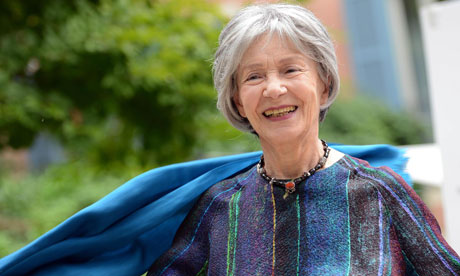
     
French movie 'Amour' by Michael Haneke
Emmanuelle Riva
      A real triumph for a late bloomer, eh? The brass ring he was aiming for all along, right? Mmm, maybe not. As gratifying as his awards must be for him, I can't help but think that Fountain, who for so long looked like a "failure" to the outside world, would have continued to write even if recognition had not come his way.

     Which has me wondering: What motivates a creative person to keep on creating?
     
      
     According to Gladwell, Fountain was sustained by a wife who believed in him and urged him to continue to plow on despite all those rejections. But Fountain himself had to love the process or I'm sure he would have quietly returned to his law practice long ago.

     Awards and recognition clearly are not what nurtures real dreams.

     Awards, in fact, can even be bad for a creative career, particularly if recognition comes too early, giving the artist the false idea that their hard work is behind them. In filmdom it's called the Oscar Curse. Adrien Brody, who at 29 was the young man ever to win the Oscar for Best Actor in 2003, was one of 13 actors CNBC included among their list of "13 Actors Hit With the Oscar Curse."

     I can't imagine Emmanuelle Riva, who at 85 is the oldest actress ever nominated for an Academy Award for Best Actress ever making such a list. The French actress -- who also is a published poet -- came to the Oscar ceremony (which was on her 86th birthday) already a winner. She had won both the BAFTA and the Cesar Awards for her role in "Amour" and, hey, who is going to forget the oldest actress ever to be nominated? It's as good as winning.

     "Everyone knows there are very few roles for older actresses. Almost none, in fact. And that is what makes all this so exceptional," Riva told the Guardian.
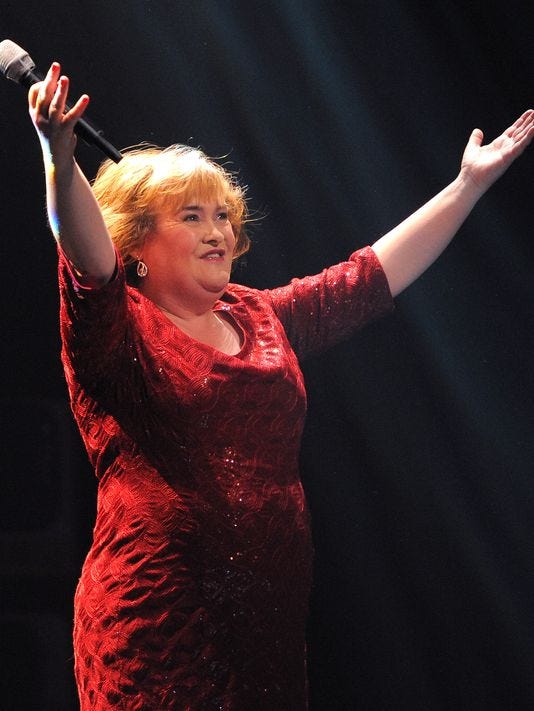
   
ANDREW YATES AFP/Getty Images
     Not winning also worked out for Susan Boyle. The Scottish singer took second place when she tried out for Britain's Got Talent in 2009. But Boyle's electric performance of "I Dreamed a Dream" from Les Miserables catapulted her into a stratosphere of fame that few achieve.

      Boyle's debut album, "I Dreamed a Dream," became the UK's best-seling debut album of all time. She's had two more albums and a makeover. She's sung for the queen and returned in triumph to Britain's Got Talent to sing "You'll See." And today, The Hollywood Reporter revealed that Boyle -- she's 51 -- will be making her feature film debut in John Stephenson's "The Christmas Candle" -- with, appropriately enough, Samantha Barks of Les Miserables. Uh, and who were the winners of that 2009 Britain's Got Talent competition?

     I am convinced though that if Susan Boyle had not captured the world's attention, she would still be out there singing. Real dreams die hard.

     For every Susan Boyle -- and Ben Fountain -- there are scads of artists who continue to sing, write, paint, act, dance and play music for the sheer pleasure of it, concentrating more on the journey than the destination.

      I think the older we get, the more we can see how this works: Creativity is an end in itself. It's nice to have an appreciative audience, but it's not really a necessary ingredient.

      In a recent class I gave at the Dali Museum in St. Petersburg on Memoir Blogging, the participants --- all over 60 -- spent some time talking about what they wanted to focus on in their blogs. One was eager to write about life with her husband, an avid motorcyclist who had recently died in a crash, "doing what he loved to do." "He was such a great story teller," she told the group. "I want to write down the great stories he used to tell about his adventures so my grandchildren will know who he was." Another wanted to tell the stories of the risky travels she has been taking in her Eighties, including a trip to dangerous areas of Pakistan. "Risk at my age is not the same as for a younger person," she said. "At this age, wouldn't you rather go out in a blaze of glory than die in a nursing home?" Still another, who had been the primary caretaker of her husband during his long illness, planned to write about coping with being a widow at 60. She called her blog The Merry Widowhood.

     None of the participants seemed all that concerned about who would be reading their blogs. Some were not even interested in ever going public with their blog, but wanted simply to write a blog for family and friends. For others I imagine that the search for an audience will come later. For now, they are caught up in telling their stories the best that they can. Writing, it turns out, is its own reward.


Monday, April 16, 2012

In the Garden of Creative Late Bloomers the Slow and Steady Plodder Wins the Race (Just Ask Charlotte Rogan)

Adding another late-in-life writer to my list of Creative Late Bloomers is always a pleasure:  Charlotte Rogan, signed her first book contract for the just released novel, "The Lifeboat," a few months after her 57th birthday.

Can you hear me say, "It's never too late"?

But Rogan's story is particular sweet because Rogan's late-in-life success did not happen overnight. She has been practicing her craft -- in secret -- for more than 25 years, writing a total of five novels. "The Lifeboat," out this month from Little, Brown, is the first one she submitted for publication.

As I have written earlier, Creative Late Bloomers come in many varieties. Not all of them are, like Grandma Moses, late starters. Not all of them are brilliant artists like Carmen Herrera who were discovered late in life by the general public. Not every late bloomer has lacked early recognition because of a heartless and clueless world. In some cases, they have needed time to hone their skills. They have needed time to do their best. Just ask Charlotte Rogan.

In the garden of Creative Late Bloomers, she is a classic Plodder.

Malcolm Gladwell describes this type of artist in his 2008 New Yorker article on Late Bloomers. He uses the example of Ben Fountain, comparing his writing life and habits to the plodding career of Cezanne.

Karl Marlantes is another good example of the The Plodder. Marlantes took three decades and many rewrites to finally finish "Matterhorn," his bestselling Vietnam War novel. "Over the years, the book got better," he says. When he published the novel, his first, in 2010, he was 65. One year later, he published a nonfiction work, "What It Is Like To Go To War," describing the lives of veterans when they return from service. 

Or how about Selden Edwards, author of "The Little Book"? Edwards toiled more than three decades before landing a book contract with Dutton. Selden wrote the first draft of this novel in 1975 and then polished and refined it for 34 years before it was accepted for publication in 2007. Selden was the oldest member of a panel of first novelists that I moderated at Portland's Woodstock Festival in 2008. He told me that he was happy no one published the work earlier. When the book finally came out, he explained, the world was much more receptive to a novel that involved time travel. 

Published this month by Little, Brown, Charlotte Rogan's "The Lifeboat" has been getting rave reviews: "terrific debut novel" (The Guardian); "remarkable debut (Globe and Mail); "spellbinding and beautifully written" (Tim O'Brien). "Other novels have examined the conscience and guilt of a survivor among the dead, but few tales are as thoughtful and compelling as this," said Cristina Ianzito in the Washington Post Book World.

One review noted the value of waiting so long before entering the publishing fray:  "Rogan's debut may be later than many writers, and arguably al the better," wrote Michael Bywater in Britain's Independent. "She has experience of life, and of 20 years' writing without the trimming and flannel of the market to coarsen her voice."

Make that 20 years plus. A mother of triplets, Rogan had been writing in secret for more than 25 years, stealing what time she could to get her stories down on paper. "Lifeboat" actually is her fourth novel. She dismissed the first three novels "as not particularly interesting, or not focused enough on plot," according to the New York Times.

And her fifth novel? Rogan wrote it when she was living in Texas surrounded by people whose politics she didn't share. George W. Bush was president. Called "Security," it was the story of a group of people living behind the walls of a gated community, trying to protect themselves.

Rogan never submitted it for publication. But who knows? I'm thinking the story now may have some legs.

As The Plodder well knows, slow and steady wins the race.


 [edit]