Wednesday, May 17, 2023

A Cast of One

By MARGO HAMMOND   

NOTE: A version of this story was first posted in Arts Coast Magazine on April 25, 2023.  

          Remember the classic pitch--A Cast of Thousands!--that Hollywood used to seduce us into movie theater seats? Now stage theaters are luring us with "a cast of one."

          Blame it on the COVID lockdown when we became accustomed to seeing actors one at a time in little square boxes. Blame it on the financial crisis facing theaters that have made them shy away from plays with large casts. Or just call it a trend. Here in West Central Florida in the past six months these type of plays have been flourishing.

          Two of the plays with casts of one that I recently saw here illustrate another reason these plays are so popular here: They have been staged in small theatrical spaces which lend potency to the experience. Although many solo plays certainly have been performed successfully on proscenium stages, the distance between the audience and the stage at those more traditional venues works against the intimacy that one-person plays thrive on.    

          In December I went to see The Year of Extraordinary Travel, written and performed by Becca McCoy and directed by Vickie Daignault (I wrote about the experience for Arts Coast Journal; you can read my piece here) at the Studio Grand Central in St. Petersburg.

          And in April I traveled to Sarasota to see Backwards Forwards Back by Jacqueline Goldfinger, performed by L. James and directed by Brendan Ragan, at the Urbanite Theater. Both venues are small black box theaters – Studio Grand Central seats 55, Urbanite seats 75. 

          At both of these plays, I watched a single actor on a nearly empty stage tell a very personal story in a very small space.

          In Goldfinger’s Backwards Forwards Back that intimacy was crucial. Actor L. James plays a soldier returning from war. Seated in an armchair with a Virtual Reality headset, he talks to us about the VR therapy he is undergoing to rid him of his PTSD nightmares. A screen behind him projects the scenes he is seeing during his therapy – a desert, a burning building.

          But it is the images of his war experience and its aftermath — including his detention of a boy whose entire family is annihilated by an incoming rocket and a harrowing scene at a Fourth of July celebration when he returns home — that remain with me still. They are the vivid images that James conjured up with his riveting performance just a few feet away from me.

In Backwards Forwards Back, a one-actor play at Urbanite Theater in Sarasota, L. James plays The Soldier, a man returning from war who is undergoing Virtual Reality therapy to try to deal with a severe case of PTSD.

          That close proximity gave me an intense experience that a larger theater would have had difficulty to match.

            Good actors, of course, can always project from a larger stage, but when it comes to one-person plays, size matters to me, I guess--the size of the theater, that is. Here's a case in point: I saw the play The Year of Magical Thinking, a one-woman play written by Joan Didion, based on her book of that title, three times--with three different actresses and in three different theaters. It was only when I saw it in a smaller venue, however, that I really got what Didion was trying to tell me.

         The Year of Magical Thinking tells the story of Didion’s wrenching and disorienting year after her husband’s sudden death.The first time I saw the play was in 2007 in a Broadway production directed by David Hare at the massive 800-seat Booth Theatre. Vanessa Redgrave was playing the role of her friend Joan Didion. Didion was even in the audience that night. I had read the book and loved it. You would think all the ingredients for success were there. But the play left me cold.

          Then in 2013 I saw that Roxanne Faye, a local actress I like, was offering the play at  The Studio@620, a creative space in St. Petersburg. It was directed by one of The Studio’s founder, Bob Devin Jones. I decided to give the play another chance. When Faye delivered the opening lines, “… it will happen to you. The details will be different, but it will happen to you. That’s what I’m here to tell you,” I remember having the distinct impression that she was talking to me and me alone. The fact that I was sitting only a few feet away. I was deeply moved by the play this time. Was it the intimacy of the space that changed my experience of the play?

          The positive impact a smaller space can have on the success of one-actor plays was reinforced when I saw The Year of Magical Thinking a third time in 2017, directed by Karla Hartley. This time  Vickie Daignault, another local actress (now a director) I admire, took on the solo Didion role. It was held at the 99-seat Stageworks Theatre, the longest running theater in Tampa, where Hartley is producing artistic director. Again, the play worked for me.

          All three actresses I saw in The Year of Magical Thinking made the work their own. Redgrave perhaps captured most accurately her friend’s demeanor as she faced down the emotions of grief. Faye showed me the normally cool Didion's struggle to fighting off those emotions. Daignault allowed me to see Didion’s open wound more clearly. Each embodied Didion’s grief and her difficulty in dealing with it.

Vickie Daignault in The Year of Magical Thinking at Stageworks Theatre

          But it was the size of the venue where I saw that grief projected that made all the difference for me as a spectator. I could almost reach out and touch both Faye’s and Daignault’s anguish, which undid me, while Redgrave remained a remote figure to me.

             There is another surprising ingredient that adds to the success of one-person plays for me, plays where a single actor holds me enthralled in a darkened space. At most of these plays I've seen, the single actor turns out to be only technically alone. Each time, an amazing number of people showed up onstage.

           Consider the four one-person plays I've seen recently at The Studio: Ann (about the legendary brash and, yes, feminist Texas governor Ann Richards), Wonderful Life (based on the iconic film It's a Wonderful Life), Roshin’s Wake (the tale of an Irish immigrant mourning her daughter's death on the Oregon Trail) and Every Brilliant Thing (the story of a boy who begins a list of things that make life worth living).       

          In Wonderful Life, St. Pete actor, drag performer and playwright Matt McGee, using his considerable acting chops summoned up no less than 15 characters. Actually, the entire cast of Frank Capra’s film It’s a Wonderful Life. American Stage producing director Helen R. Murray and Jason Lott adapted that classic film for this stage version.

          With only a slight turn of his body or change of his voice, McGee transformed himself into George Bailey and George’s wife Mary and Mr Potter and George’s brother Harry and Uncle Billy and the floozy Violet and, of course, Clarence the Angel. There wasn’t a prop in sight (except that pair of glasses on Mr Potter).

          McGee performed the engaging play in December at four locations here: The Studio Coastal Creative, and the James Museum (all spaces in St. Petersburg) and at Gulfport’s Catherine A. Hickman Theater. Earlier last year he appeared in a one-person play at freeFall, another St. Petersburg theater venue, portraying James Beard in I Love to Eat. Talk about earning your wings.

Matthew McGee bringing the town of Bedford Falls onstage in Wonderful Life          

          Or consider all the voices that I heard at Every Brilliant Thing, thanks to that play’s cleverly orchestrated interaction with audiences. The one-actor play by Duncan McMillan with Jonny Donahoe is about a six-year-old boy who began a list of brilliant things to convince his suicidal mother that life was worth living – and who continues to add to the list all his life.

          In the script the actor is instructed to use members of the audience to shout out the items (which were printed on numbered slips of paper and distributed by the actor beforehand). The script also calls for audience members to be used as stand-ins for the people who populate this touching story (also negotiated by the actor before the play began).

          So picture this – we are seated in the round at The Studio with actor Dylan Barlowe (who plays “the Narrator”) in the center. He is explaining to us how at six he came up with the idea for the list when he suddenly calls out “Number 1” (the first item on his infamous list) and the woman next to me exclaims, “Ice Cream.” Later, when Barlowe says “Number 4,” someone in the bleachers across the way yells out, “Laughing so hard you shoot milk out your nose.” And so on.

          As he continues to tell us his heart-breaking but ultimately life-affirming story, his father, his school counselor Mrs. Patterson (and her sock puppet Booger), a lecturer and girlfriend Sam miraculously materialize, all thanks to audience members willing to play these parts. At one point, to cheer us up, Barlowe (who attended the Pinellas County Center for the Arts) even gets all of us to do the wave.

Dylan Barlowe bringing the audience into the story in Every Brilliant Thing

          The audience also became part of the drama at Ann, which I saw in October, and Roshin’s Wake, which had its world premiere here in December. Ann, written by Holland Taylor who originated the role, begins with the governor addressing a graduating class. We in the audience are, of course, the stand-ins for the students.

          At Roshin’s Wake, a story written and performed by Dorothy Hershman of an Irish immigrant traveling across the Western territories on the Oregon Trail – programs were handed out to us making it crystal clear that we were once again expected to play our part: “Imagine yourselves ‘In-Role” as fellow travelers on this wagon train.”

          The Studio first presented Ann to sold-out crowds in the spring of 2022. In October the biographical play made famous by Holland Taylor on Broadway was back at The Studio by popular demand. All of the original creative team returned, headed by the indefatigable Bonnie Agan as Ann. Lisa Tricomi, who directed the Studio’s production, called the play “a love letter to democracy.”

          Ann started out in the auditorium of a college graduation, but the setting quickly expanded to a convincing re-creation of the office of the governor of Texas (thanks to production stage manager Marcus Wehby), complete with American and Lone Star State flags.

          There, Agan as Richards launched into a full, multi-tasking frenzy, yelling at her pokey speechwriter, giving a filmmaker a quote about abortion rights, telling a dirty joke, talking to Bill Clinton (who was then in the White House), ordering cowboy boots for her staff, debating whether she should issue a last-minute stay of execution, fixing the fringe on the American flag and acting as referee as she plans an outing with her kids.

          At play’s end, I found myself with tears in my eyes, first from laughing so hard at Richard’s saucy personality and then in sorrow when Ann described her own funeral. It is a tribute to Agan’s gutsy performance to say that I would swear that there were dozens of other people onstage with her as she switched seamlessly from phone call after phone call to conversations with her assistant (who is a pre-recorded voiceover) to rants about the need for more political participation.

Bonnie Agan portraying Ann Richards on the detailed set designed by Marcus Wehby

          In contrast to Ann’s elaborate office mise-en-scene, the setting for Roshin’s Wake was chillingly stark – just a tree stump and a wooden cross.


The stark stage setting for Roshin's Wake, and Dorothy Hershman, who wrote, directed, and performed Roshin’s Wake, during the play’s final talkback at The Studio@620 – photos by Margo Hammond

          The play tells the story of Oognah Donohue whose daughter has just died in childbirth. When the play opens, Donohue is mourning at her daughter’s gravesite which she will soon have to abandon when the wagon train she is on moves westward.

           And just as the program predicted, Dorothy Hershman, who wrote, directed and performed Roshin’s Wake (with a convincing Irish accent), addresses us directly as if we were indeed her fellow travelers, inviting us in the end to join the others for the Irish wake that they are holding to help her through her grief.

           Hershman, an award-winning actor, moved to Gulfport from Texas in 2000 to take a job as a drama specialist for the lower grades at Berkeley Preparatory School in Tampa. It was there that she got her inspiration to write Roshin’s Wake.

          When the 5th graders were learning about the Oregon Trail, she would help them do improvisations — or what she calls “process drama, exploring a subject by going into it and living it” — to make the period come alive for them. (Read her interview with Bill DeYoung in the Catalyst).

          In 2015 she retired from Berkeley, but she never left the Oregon Trail. During the pandemic lockdown she tapped into the many years of research she had done on that period and wrote down the story she tells in Roshin’s Wake.

          Roshin’s Wake was produced by Francine Wolf whose Largo-based ZaZu Productions L.L.C. created a promo for the play’s world premiere at The Studio@620.

          Wolf herself is no stranger to one-woman performances. She presented her own solo play based on her life, Please Don’t Tell My Kids!, this month at the Tampa International Fringe Festival (and will be presenting it at the Fringe Fort Myers in June). Her Tampa performances were held at Screen Door, a 36-seat microcinema in the historic Kress building in Ybor City.


Poster for Francine Wolf’s solo play Please Don’t Tell My Kids!


Monday, May 1, 2023

Getting Personal: Tchaikovsky and Me

          Yesterday I went to hear the Tampa Bay Symphony play Tchaikovsky's 6th Symphony at the Straz Center in Tampa. My friend Ruth Kern plays the cello in this amazing, all-volunteer orchestra. It was the second time I heard the TBS play the piece. As I sat in the darkened theater, listening to this monumental work, I thought back to the first time I heard the TBS play Tchaikovsky's final piece of music at the Palladium in St. Petersburg.

          It was on February 18, 2014, the day I learned that my childhood friend Tom Valeo was dying of cancer.

          Tom and I had grown up together in Kenosha, Wisconsin. I adored his mother who, like me, was of Scandinavian descent. I was a bit in love with his Italian father who was a labor leader. He never laughed at my youthful opinions about the state of the world. Our families thought Tom and I might end up getting married, but it wasn't like that. He was like a brother to me. A brother without the baggage of sibling rivalry. 

          We both ended up working as journalists. He got married, had three kids, moved to Chicago (where he covered the theater scene for the Daily Herald), and got divorced. I got married, got divorced, became a travel writer, eventually moved to St. Petersburg to take up a more sedentary job as book editor of the St. Petersburg Times and remarried. We kept in touch no matter how far apart life took us. 

          Then suddenly, miraculously, he was living again in the same town as I was. I had introduced him to a friend and colleague of mine, Karen Pryslopski, and they had fallen in love. He moved to St. Petersburg and moved in with Karen.


          When they finally got married, Tom asked me to be his best "man" at their wedding, which took place, appropriately, in their kitchen. They were both amazing cooks.


          For years I would tell people that pairing up Tom and Karen was the greatest accomplishment of my life. I had never seen two people so happy together. 


          Recasting himself as a science writer, Tom first worked at their kitchen table and then in an office that Karen fixed up with posters of Chicago and a photo of Tom meditating under a Florida tree (used to illustrate a cover story he wrote on the benefits of mediation as we age). In addition to writing about science, he gave lectures on the art of writing and ran workshops encouraging people to begin their "existential memoirs." He saw writing as an act of meditation, a chance for deep self-reflection. 


          Karen was still working full-time at the newspaper, but both of were freelancers by then. We would meet in the afternoons over the cappuccinos that he would whip up with his amazing state-of-the-art machine to talk about our work and the state of the world.


       Then in 2014 four days after Valentine's Day (a holiday none of us were very fond of), I got a call from Tom, asking me to stop by. He said that he had something important to tell me. Karen was at work. He was in the kitchen, as usual, making us cappuccinos. When I walked in, he dropped the bombshell: He didn’t have long to live.     

           He asked me not to tell Karen that there was no chance of recovery. When he had felt a pressure in his upper chest, the science writer in him knew immediately what a doctor confirmed: He had an advanced case of esophageal cancer. He was prepared for what was to come. Karen needed to keep hoping for a miracle, he told me. I promised him I would stay by her side with all the support I could muster.


          That night I went to the Palladium in St. Petersburg to hear Tchaikovsky's 6th with my friend Ruth at the cello. As the piece opened with its mournful bassoon solo, I began to cry and never stopped until the music ended. I gave myself over entirely to the symphony, letting it carry me through its themes of life and death. At the end of the fourth and final movement instead of the usual triumphant, Ta Da I was used to hearing at the end of symphonies, the music merely faded away. I walked out of the theater, knowing I would never forget that day or that music.


          Tchaikovsky called his 6th Symphony the Pateticheskaya Symphony, using the Russian word which means passion or emotive. The French translated that word as "pathetique," which suggests something emotional, evoking pity. That moniker, which is how the piece is known today, seemed all-too-prophetic when Tchaikovsky died only nine days after he conducted its premiere in St. Petersburg (the other St. Petersburg of course) in 1893. Was the symphony a suicide note? Did Tchaikovsky know he was dying? Did he mean to evoke pity?


          There has always been a great deal of mystery surrounding Tchaikovsky and his last symphony. Some have speculated that he was writing his own requiem because the truth of his sexual orientation was about to be made public. Others say that is nonsense. He contracted cholera after the premiere and couldn’t possibility have known that he was about to die when he was writing the work. 


          There are several facts that are undisputed. We do know that Tchaikovsky had tried to commit suicide in the past--after his marriage  to Antonina Miliukova, a former student, spectacularly fell apart. We do know that he was gay. But there is evidence that he was comfortable with his sexuality (his orientation was an open secret among musicians and those close to him) and that 19th century Russia was not as intolerant of homosexuality as present-day Russia is. 


          "Biographer Alexander Poznansky, the first scholar to access Tchaikovsky's extensive letters--previously suppressed by Soviet authorities--convincingly argues against the suicide theory," says my cellist friend Ruth in the program notes she wrote for TSO's most recent performance of Tchaikovsky's 6th.


          We’ll never know, of course, what Tchaikovsky really was thinking when he composed the PathĂ©tique, but I do know that night in 2014 when I first heard the Tampa Bay Symphony play it, his music transcended biography. His notes rattled my heart.

. . .

          I had many months to say goodbye to Tom before he died on Earth Day in 2015. We had several more dinners together, many more days of laughter and I was able, repeatedly, to tell him how much he had meant to me in my life, how much I was going to miss him.


          That was a conversation I was never able to have with Karen. She unexpectedly died just under six years after Tom's death. It was early 2021. From a fall perhaps. We don’t know. When she didn’t answer our calls, friends went to check up on her. They found her unconscious in her bed. She never woke up. We had braved that first year of the pandemic together, only to have one of us die of something that had nothing to do with COVID.


          I had kept my promise though. I had stood by her as best as I could. We marked every Earth Day with a dinner al fresco on Beach Drive. We audited classes together at USFSP and tried out new restaurants. She cooked for me. I brought her wine. A mutual friend who plays violin with the Florida Orchestra got us tickets to dozens of concerts.


          Karen had never been to a symphony orchestra. "What should I wear?" she asked, the first time we went. "It's Florida," I told her, "Anything goes, but shorts." At every concert after that, she delighted in pointing out to me someone who had come in shorts. She always insisted on sitting as high up as possible so we could see the entire orchestra. She called the first violinist her “boyfriend.” She had never seen a musician so animated.

          Last fall when a friend invited me to go hear a Florida Orchestra performance at Mahaffey Theater, I was delighted that his tickets were in the mezzanine, Karen's favorite spot. I found myself looking around for a guy in shorts. I laughed when I so easily spotted someone. Tchaikovsky was on the program. Not his 6th but his 4th. 


          Tchaikovsky's 6th, of course, will always remind me of Tom–and you might imagine that now the PathĂ©tique, linked to the composer’s sudden and mysterious death, would also make me think of Karen.


. . .


          But it is Tchaikovsky’s 4th that I associate most with her. Tchaikovsky wrote his 4th symphony after that failed suicide attempt when he was trying to be happy once again. Its bittersweetness and triumphant finale addresses perfectly the time I had together with Karen after Tom's death, when both of us were trying to cope with sadness.


         Describing his achingly beautiful second movement, which opens with the melancholy sounds of an oboe solo, Tchaikovsky wrote:  “Life has you tired out. Many things flit through the memory… there were happy moments when young blood pulsed warm and life was gratifying. There were also moments of grief and of irreparable loss. It is all-remote in the past. It is both sad and somehow sweet to lose oneself in the past. And yet, we are weary of existence.”


          But it is Tchaikovsky's comments about the last movement of the 4th, with its joyous sound of cymbals, that made me realize why I will forever link Karen to this work of art. His words underscore how important it is to turn to others when you are grieving a loss:


           “If you cannot discover the reasons for happiness in yourself, look at others. Upbraid yourself and do not say that the entire world is sad…


          “Take happiness from the joys of others. Life is bearable after all."


          Hearing Tchaikovsky's 6th symphony again this week, I found myself once again grateful for the healing power of music. I was struck by the thought that Tchaikovsky's symphonies are in a way the musical equivalent of Tom's existential memoirs, deep dives into the composer's angsts as well as his triumphs. The fact that an artist shares with us his or her personal reflections--whether they take the form of music, writing or any other art-- is our gain. Through that sharing, we are encouraged to reflect on our own personal joys and losses. What else is the point of art?


          Tchaikovsky once said, “Truly there would be reason to go mad were it not for music.” Listening to his final symphony this week, to that I would add, truly there would be reason to go mad were it not for the music of friendship.


A version of this essay was posted last year in Arts Coast Magazine, prompted by a question the editor of that online magazine posed to those of us who are regular contributors. Sheila Cowley asked us, "Is there something in a work of art, some detail you noticed, that made that work special for you?" At first, nothing came to mind. Then, all of a sudden, I thought of Tchaikovsky and how his two very personal symphonies had become very personal for me.


Saturday, April 15, 2023

BACK-TO-BACK LITERARY FESTS: PART II

Last fall St. Petersburg hosted two back-to-back literary festivals. Scroll down to read Part I, my take on the first ever St. Pete Reads! Lit Fest at the Woodson African American Museum of Florida. Here is Part II, my look at the re-imagined Times Festival of Reading held at the Palladium. 

THE TIMES FESTIVAL OF READING TURNS 30

Turning 30, the Times Festival of Reading slimmed down this year. There were fewer authors. The venue was smaller. And it was no longer free. But two essential ingredients stayed the same – inspiring authors and enthusiastic readers.

Fifteen authors took to the stage of the 800-seat theater at The Palladium in downtown St. Pete for author talks and panel discussions from 9 to 5 on Saturday, November 12. Festivalgoers paid $25 for general admission or $50 for a VIP badge, which provided preferred seating, access to a morning coffee hour, two tickets for drinks at an evening Happy Hour and a 15 percent discount on books. Book sales and book signings were set up downstairs in the Side Door Cafe by Tombolo Books, a local independent bookstore.

Perhaps because of the admission fee, the crowd skewed decidedly older. “I remember when the festival was a two-day affair at Eckerd,” one silver-haired woman said as she checked in. “They had really big authors back then, like David McCullough.” Her companion, however, said she didn’t miss all the walking that she had to do when it was held on the campuses — the festival moved from the Eckerd College campus to University of South Florida St. Petersburg in 2005. “It’s easier now that everything is concentrated in one place.” Perhaps the age of the audience also explains why the afternoon talks drew the largest crowds.

The day began with an interview with Barbara C. Cruz, Jeff Houck and Andrew T. Huse, co-authors of Cuban Sandwich: A History in Layers  by Times book critic Colette Bancroft who as a self-described “Tampa girl” admits she favors that city’s version of the famed food. As the authors pointed out, however, the real story of the Cuban sandwich is complicated.

The next talk was a more sobering discussion between Pulitzer Prize-winning journalist Lane Degregory and Beth Macy about the nation’s ongoing opioid problem. In her latest book on the crisis, Raising Lazarus: Hope, Justice, and the Future of America’s Overdose Crisis, Macy looks at both the victims of the still unsolved epidemic and those who have helped, not demonized, those victims.

Beth Macy, author of Raising Lazarus: Hope, Justice, and the Future of America’s Overdose Crisis, at the Times Festival of Reading

Macy calls those heroes “stone-rollers.” Her title, she explained, was not named for Narcan, the so-called Lazarus drug that has brought addicts back from the brink of death, but refers to Jesus’ command to his followers in the New Testament to roll away the stone from Lazarus’ tomb – a call to the community, says Macy, to “do the stinky, messy work” to combat the crisis.

After lunch three books were presented — by a novelist, a journalist and an historian — that all touched on same subject:  race. Dennis Lehane, Charlayne Hunter-Gault and Peniel E. Joseph each provided a different perspective on that ever-elusive conversation that we all keep calling for but never manage to pull off having. Here at least, was a start, I thought.

Dennis Lehane signing copies of his past books – his latest book, Small Mercies, won’t be released
until April 25

Racial violence is at the heart of Dennis Lehane’s upcoming novel Small Mercies. The book, he said, was inspired by the rage he felt as a 9-year-old living in Dorchester, Massachusetts in 1974 when he found himself surrounded by racists, many of whom were his own family members. The 9-year-old Lehane isn’t a character in the book but “Southie,” the tough Irish-American Boston neighborhood where he grew up, and the violence that exploded during the long, belated desegregation of his schools, are.

Small Mercies, Lehane’s 14th novel and the first in five years, won’t be available until April 25. “Oh, great,” he quipped to Bancroft who was interviewing him. “We’re getting everyone psyched about a book they can’t read for six months.”

TV viewers, however, can watch his Apple TV+ crime drama mini-series Black Bird starring Greg Kinnear, Bancroft pointed out, and pre-order a signed book from Tombolo Books. Lehane is an Eckerd College alum and co-founder of Writers in Paradise, a writer’s conference held on that campus every January.

Times book critic Colette Bancroft interviews Charlayne Hunter-Gault whose latest book, My People, is a collection of essays culled from her five decades in journalism.

Journalist Charlayne Hunter-Gault’s new book, My People, is a collection of five decades of her reportage and commentary on Black lives. Two of the pieces in the collection are about South Africa’s Nelson Mandela – her interview with him in 1990 when the anti-apartheid activist first was released after 27 years in prison and his funeral in 2013.

In that first interview, she said, by responding yes to Mandela’s question, “Did she known Maya Angelou?” (she really only knew of her from her work), she got her “scoop.” Mandela told her that he had read all of Angelou’s work while in prison.

At 18 Hunter-Gault was one of two Black students to integrate the University of Georgia. Three days later a riot broke out in front of her dorm. In a question-and-answer session, an audience member asked her if she thought the United States needed a truth and reconciliation commission like the one promoted in South Africa by Desmond Tutu. Ever the journalist, she turned the question back on her questioner, asking him what he thought that process should look like here. Reparations in some form, he responded, but above all truth-telling.

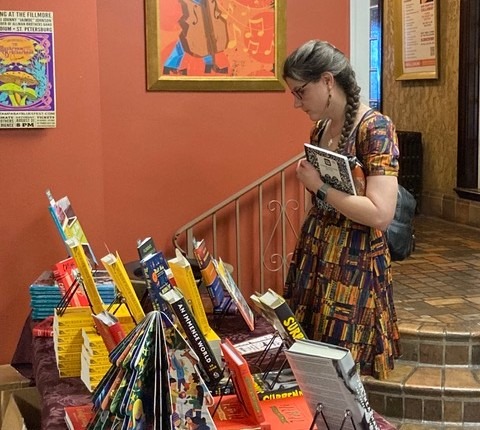
Copies of The Third Reconstruction by Peniel E. Joseph on sale from Tombolo Books at the
Times Festival of Reading

The need to confront the truth about America’s racial past was forcefully addressed during the talk by Peniel Joseph, author The Third Reconstruction. Joseph was interviewed by fellow historian, retired USFSP professor Ray Arsenault, author of Freedom Riders, which describes a pivotal moment of the Civil Rights Movement, a period often referred to as the nation’s “Second Reconstruction.”

The term “Third Reconstruction,” explained Joseph, has been employed by a number of historians and social justice activists, including William J. Barber (whose book with the same title came out in 2016) to describe the latest attempts to correct civil and human rights abuses that have lingered since the First Reconstruction after Civil War failed. Joseph’s book defines the Third Reconstruction as the period from 2008 to the present, from the election of Barack Obama to the rise of the Black Lives Matter movement.

Peniel E. Joseph listens intently to a festivalgoer who bought his book, The Third Reconstruction, at
the Times Festival of Reading

“Since 1865 the United States has been locked in two different competing stories. One of the stories is a reconstructionist story that supports multi-racial democracy… and multi-racial justice for all people… not just Black, white but Latino, Asian-Americans, Indigenous folks, queer folks, the whole range,” said Joseph who himself was raised in a segregated area of New York City by Haitian immigrants.

“The other story is the redemption story, the story of the lost cause. And in order to understand MAGA, in order to understand Trump and the roots of our own partisan political divide, we have to go back to the Civil War.”

Festivalgoers were obviously interested in continuing the conversation about race started by these authors. Joseph’s book signing line was the longest of the day.

Ray Arsenault, who interviewed fellow historian Peniel E. Joseph, author of The Third Reconstruction, at the Times Festival signs copies of his own book, Freedom Riders, about a pivotal moment in the Sixties during the Civil Rights Movement, which is often referred to as the Second Reconstruction.

The most ubiquitous subject at the festival, however, was Florida. Florida-based authors and Florida topics dominated the roster. New York Times bestselling author Lisa Unger, who lives on the Pinellas coast, talked about her latest psychological thriller — her 20th. Even the title sends chills down your spine, Secluded Cabin Sleeps Six.

Two Florida-based historians were paired up in another session – Gary Mormino (Dreams in the New Century: Instant Cities, Shattered Hopes, and Florida’s Turning Point) and University of Florida professor Jack E. Davis (The Bald Eagle) who specializes in environmental history.

Alsace Wallentine, co-founder of Tombolo Books, helps a customer at the Book Mart the independent bookstore set up at the
Times Festival of Reading

“What made you want to become an historian?” Bancroft asked the historians. “I wanted to become a writer,” Davis admitted, a bit sheepishly. “When you write history, you get to tell stories.” Historians, Mormino agreed, are “the best writers in the academy today. They are writing stories — stories with a purpose.” They are also writing stories with characters that can carry the narrative in books that borrow some of the same techniques as fiction writers to keep readers interested, Bancroft pointed out.

“If you can’t find characters in Florida,” laughed Mormino, who specializes in Florida history, “you need to give up writing.”

And as if to prove that point, three Florida-based authors, appearing together on a panel, regaled us with the tales of some pretty interesting characters they encountered while writing their books, all of which embrace the weirdness of the Sunshine State. . .

  • Kristen Hare (100 Things to Do in Tampa Bay Before You Die) went to check out Linger Lounge, the Bradenton restaurant famous for its good food and taxidermic decor. When she found a Road Kill menu inside the regular menu, a waitress suddenly whisked it away, telling her that it was too late to order from that menu. The roadkill items had to be ordered in the morning so someone could be sent out to harvest them, she said, winking as she walked away.
    . . .
  • Craig Pittman (The State You’re In: Florida Men, Florida Women, and Other Wildlife) interviewed the man who had found the first python in the Everglades. He was on a date when he saw the 11-feet-long creature lying dead on the highway (another road kill story!), he told Pittman who had reached him by telephone in Washington State. When he went to retrieve it, his date objected, saying, “Not with me in the car.” He told her he would come back for her. “He didn’t get a second date,” said Pittman.
    . . .
  • Paul Wilborn (Florida Hustle) admitted that in his fiction Charlie Wall, who ran the numbers racket in Tampa, survives his whacking by fellow mobsters in 1955. He was too colorful a character to let die, said Wilborn.
Paul Wilborn, Kirsten Hare and Craig Pittman hold up the books they presented at the 30th annual Times Festival of Reading. Wilborn, in addition to being a featured author, was, as the executive director of the Palladium was also the event’s host.

Wilborn was not only a featured author at the festival, as the executive director of The Palladium Theater, he was also the host. “I’ve been a fan of this festival since it was at Eckerd College and I followed it to USF and I was worried that it might not come back after COVID, so when (the Times) reached out and thought the Palladium might be a spot, I said, ‘Absolutely how can we make it happen?’” he said.

“So far we’ve heard good reports from the fans. I hope they come back.”