Sunday, November 25, 2012

How Late Does a Bloomer Have to Be to Make a Late Bloomer List? Not That Late.

       The new list of late bloomers -- "10 Great Literary Late Bloomers"  -- just posted on the internet has me wondering: How late does a bloomer have to be to make one of these lists? Not so late, it seems.


Emily Temple
Emily Temple
    The current roll call was compiled by Emily Temple, the literary editor at Flavorpill, an internet city guide started in 2000. According to Temple's Linked-In profile, she graduated from Middlebury College in 2008.

    Which may explain why most of the writers on her list are just barely showing their grey.

      One of them  -- Anthony Burgess -- was a boyish 39 when he made his fiction debut. (Oh, okay, he was 45 when he hit the literary jackpot with "Clockwork Orange," but that's still younger than all but two of our U.S. presidents).
   
     The older I get, I guess, the higher the age a late bloomer needs to be.


Laura Ingalls Wilder
     Five more on Temple's list (Deborah Eisenberg, William Burroughs, Helen DeWitt and Raymond Chandler) were only in their early forties when they bloomed on the literary scene. And two more (Charles Bukowski and the Marquis de Sade) were barely into their fifties.  Literary late bloomers? I tend to think of them as writers who either started or found success in their fifties and up.

     So, yes, for me the last two on Temple's list definitely quality: Donald Ray Pollack was 55 when he debuted with a short story collection and 58 when he published his first novel last year. And, Laura Ingalls Wilder -- the only silver-haired among the lot -- was without a doubt a late bloomer. She published her first novel -- "Little House in the Book Woods" when she was 64.

      Temple says she was inspired to create her list of literary not-so-late bloomers after she discovered a "cool website dedicated to the discussion of writers who published their first major work at age 40 or later." The website, called Bloom, is indeed cool, a place "where you'll encounter the work and lives of authors ... who bloomed in their own good time."


     But consider this: That site was founded by Sonya Chung, a novelist who once told an interviewer that she considered herself a late bloomer because she only began writing in "her late twenties." 


Photo credit: Robin Holland
Sonya Chung
     Chung is also the force behind the inspiring "Post-40 Bloomers" series at The Millions, which was launched in 2011 in the wake of the outcry over that year's New Yorker "20 Under 40" list. "Why do the kids get so much of the good stuff?" asked Martha Southgate in "Older and Wiser," also posted on The Millions.

     Chung wanted writers over 40 to get some good stuff, too. In her first column introducing the Post-40 series, Chung said she appreciated Malcolm Gladwell's distinctions among "late bloomers, late starters and late-dicoverereds," in his popular New Yorker article on "Late Bloomers," but admited her own bias was toward late starters -- "people who have lived a whole life, or two, or three before seriously devoting themselves to write a book."


     But it's hard to imagine that those she and others have profiled in the "Post-40 Bloomers" series have had time to live three lifetimes. Like the writers on Temple's list, most were already successful by their forties and early fifties:

     * Spencer Reece who had been submitting his poetry for 13 years and was rejected some 300 times over before both a publisher and The New Yorker recognized his work when he was...40.

     
    * Walker Percy who published "The Moviegoer," at 44 
     
    * Novelists David Abrams and Anna Keesey who were 49 when they published their first novels
     
    * Mary Costello who finally found success with her short stories in her mid-40s
                                             
    * Short story writer Susan Starr Richards who published her first collection at 49 
                                            
    * Isak Dinesen whose literary star started to ascend at 50, just as her physical deterioration accelerated
                                           
    * David Orozco whose "debut" collection at 52 was 16 years in the making

      
     To be fair, the Post-40 series hasn't completely overlooked writers who have achieved success in their late fifties, sixties and seventies. The fact that one of them didn't actually live long enough to see that success was a bit disconcerting. But let's not quibble. We late late bloomers will take all the role models we can get:


William Gay
   William Gay, a self-taught wrier who finally managed to publish two short stories at age 55 and then was offered a book contract for his novel the next year

     * Stephen Wetta who took 56 years to learn to write in the voice of his 12-year-old self
     
Harriet Doerr
     * Giuseppe Tomasi di Lampedusa who began working on his one and only novel, "The Leopard," when he was 58 and finished it when he was 60 (alas, only to die before it was published posthumously the next year)
      
     * Mary Wesley who found success publishing young adult fiction in her 70s

     *  Harriet Doerr who won the National Book Award for her first novel when she was 74

     
     And I'll give this to Chung: She was on to something when she deliberately left out the word "late" and "older" in her "Post-40" title:  "Late relative to what and according to whose definition of early or on-time?" she asked.

     
     Indeed. Will I still think of Laura Ingalls Wilder as a late bloomer when I am in my seventies and eighties? 
     
     Perhaps not. Clearly, late is in the age of the beholder.


     10 Great LIterary Late Bloomers

Monday, November 12, 2012

Fifty Shades of Grey for the Grey-Haired Crowd: Books About Sex, Love and Aging

    Here's a delicious story: Rejected for 20 years by the old, traditional publishing route, an older woman is hitting it big with a novel about sixty-something romance, thanks to the upcoming, new kid on the publishing block: the ebook.

hilary boyd
Hilary Boyd in north London. Photograph: Andy Hall for the Observer

    English journalist Hilary Boyd had published six non-fiction books on such subjects as pregnancy, step-parenting and depression, but she never gave up writing fiction. Finally, last year she published her first novel, the story of a romance between 60-somethings who meet in a park while the woman is looking after her grandchildren. Alas, Thursdays in the Park, didn't exactly fly off the shelves; it sold under 1,000 copies. But this year Boyd's publisher, the independent imprint Quercus, posted the novel on Amazon as an ebook and something surprising happened.

    As an ebook, Thursdays in the Park began selling like crazy, topping more than 100,000 copies. Now Boyd has sold translation rights to the novel, which is also available in paperback, in France, Sweden, Finland and Germany and English director and actor Charles Dance (he once played a Bond villain) wants to make a movie of the story. At 62, Boyd has a bestseller on her hands.

      Obviously, there's an untapped market for novels about middle-aged love among Kindle readers. "Old people falling in love and having passionate relationships is not a story that's had much exposure before, but I'm in no doubt that the market's out there," Boyd told the London Observer. 

       It's the same market that flocked to "The Best Exotic Marigold Hotel" and "Hope Spring."  It may even be the same audience that has been reading Fifty Shades of Grey. Why should the rules be any different for an older crowd? If you get the packaging right, sex obviously sells.
       
     The London Observer heralded Boyd's ebook success as a sign of a rise in gran-lit, but books addressing the subject of sex, love and aging are not really new. What is new is the packaging. As baby boomers get comfortable with using Kindles and Nooks, I suspect there will be more demand for ebooks -- both novels and memoirs -- that speak to the challenges that sex and love pose as we age. Meanwhile, here are some of my favorites that I read in old-fashioned book form: 

NOVELS

My Dream of You, by Nuala O'Faolain
On the eve of her 50th birthday Kathleen a writer living alone in a basement apartment in London, has all but given up on love. She returns to her native Ireland and researches a 150-year-old mystery about an infamous love affair and ends up finding her own unexpected path to love in the process.

Julie & Romeo, by Jeanne Ray
Front Cover
What would you do if your widowed mother or father began dating? The children of Julie and Romeo are not thrilled with that prospect in this light-hearted novel about steamy late-in-life romance. with a nod to the Bard, the trysting widow and widower hail from two bitterly feuding families who own the town's rival florist shops. But don't expect a tragic ending from Ray, who is the mother of novelist Ann Patchett. Age does have its privileges.

The Leisure Seeker, by Michael Zadoorian
John and Ella Robina have been together for more than 50 years. Now in their 80s, they both face serious illness. Ella has cancer; John has Alzheimer's. They decide to escape from their doctors and adult children and go off on a final adventure, running away from Detroit for a cross-country trip.

Love in the Time of Cholera, by Gabriel Garcia Marquez
Boy meets girl. Girl rejects boy. Boy waits fifty years to get his chance again. Marquez's classic novel begins with a comical death and ends with the long-delayed union of Fermina Daza and her old sweetheart, Florentino Ariza. The two chapters point to the unexpected twists life offers. But they also bookmark a tale that unexpectedly offered something that had been rare in literature: sensual scenes of late-in-life romance. "It is life more than death that has no limits," writes Marquez.

MEMOIRS

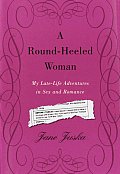
A Round-Heeled Woman: My Late-Life Adventures in Sex and Romance CoverA Round-Heeled Woman: My Late-Life Adventures in Sex and Romance, by Jane Juska
The author ran a personal ad in the New York Review of Books: "Before I turn 67, I would like to have sex with a man I like. If you want to talk first, Trollope works for me." She then wrote this refreshingly honest account of what happened next.

Without Reservations: The Travels of an Independent Woman, by Alice Steinbach.
Middle-aged and seeking adventure (but not too much), Pulitzer Prize-winning journalist Steinbach ventures alone to Europe to let her hair down. She wants to experience life, not just observe it. This divorced mother of two grown son finds romance with a Japanese businessman in Paris, goes ballroom dancing in Oxford and almost gets mugged in Rome. "This is what I will have forever," she says on her last day. "The memory of this moment, of rain falling on Venice."

Somewhere Towards the End: A Memoir, by Diana Athill
Long-time publisher Diana Athill in her 90s takes a hard look at growing old and concludes that its advantages outweigh its disadvantages in this funny, brutally honest chronicle of her own loves and long life.

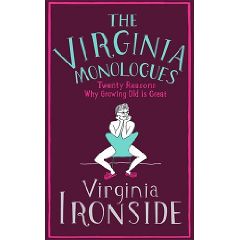
The Virginia Monologues: Twenty Reasons Why Growing Old is Great, by Virginia Ironside (based on her stage play)
Ironside embraces her inner (and outer) oldster. She thinks growing ancient is a gain not a loss. So much the better if your memory is going. You can forget the bad times, like all the creepy men you slept with in the other sixties. She gives plenty of advice: Take lots of drugs, and not just those prescribed by your doctor. Talk about your various ailments ("I take so many fish oils I'm thinking of joining an aquarium"). Enjoy your grandchildren ("The reward for not killing your children.") As for sex, she's over it: "I have to admit that, at 65, I think I've had enough sex to last me a lifetime -- and I know I'm not the only one...I've found one can have so much better relationships now sex is out of the equation."


Post Scripts: A Writing Life After Eighty, by LaVerne Hammond
LaVerne Hammond (my mother) wrote this collection of columns and essays for senior section of the St. Petersburg Times (now the Tampa Bay Times). Hammond sold her first piece to the newspaper when she was 86. Many of her columns address the subjects of love and old age and, yes, even sex. In one column she describes how she managed to keep the sexual fires burning in her own long marriage of 52 years. In another, after the death of her spouse, she offers advice on dating in your eighties and nineties. Hey, it really is never too late.


Friday, October 5, 2012

CREATIVITY IN A WEEK: SENIORS SING, DANCE AND ACT (AND IN MY CASE, WRITE ABOUT IT)

     In August I spent a week at the Chautauqua Institution, a sprawling resort in western New York, to attend an senior arts boot camp, led by Jeanne Kelly of Encore Creativity. I followed seniors in each of the three arts tracks offered at the camp and wrote an article for the Washington Post's Style section. My piece has just been posted at the Washington Post website: Seniors sing (and dance and act) for their health.

Here are the seniors I followed during the week:

DANCE


     Sixty-seven-year-old Florence Crisp of Alexandria, who drove up in a carload of other former Foreign Service officers to the arts boot camp, didn't let her two artificial knees stop her from joining the dance track.


THEATER


Sixty-one-year-old Noel Miner, who joined the theater track, made an appropriately grand entrance onto the Chautauqua grounds in western New York with her husband and biggest fan Harold on their 2010 Harley Tri-Glide from their home just outside Orlando. 


CHORUS


When George Lane, 81 (at right) of Gaithersburg, Md., told Encore Creativity he needed a ride to Chautauqua, Jeanne Kelly put him in touch with Vin Kelly (left) of Chevy Chase.  Coincidentally, the two had been neighbors 30 years ago in Silver Springs. They are also both tenors.