Saturday, April 15, 2023

BACK-TO-BACK LITERARY FESTS: PART II

Last fall St. Petersburg hosted two back-to-back literary festivals. Scroll down to read Part I, my take on the first ever St. Pete Reads! Lit Fest at the Woodson African American Museum of Florida. Here is Part II, my look at the re-imagined Times Festival of Reading held at the Palladium. 

THE TIMES FESTIVAL OF READING TURNS 30

Turning 30, the Times Festival of Reading slimmed down this year. There were fewer authors. The venue was smaller. And it was no longer free. But two essential ingredients stayed the same – inspiring authors and enthusiastic readers.
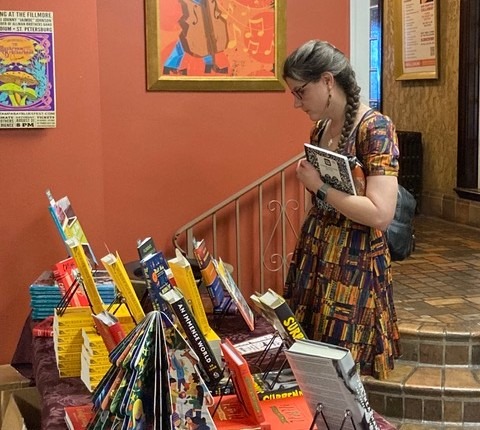
Fifteen authors took to the stage of the 800-seat theater at The Palladium in downtown St. Pete for author talks and panel discussions from 9 to 5 on Saturday, November 12. Festivalgoers paid $25 for general admission or $50 for a VIP badge, which provided preferred seating, access to a morning coffee hour, two tickets for drinks at an evening Happy Hour and a 15 percent discount on books. Book sales and book signings were set up downstairs in the Side Door Cafe by Tombolo Books, a local independent bookstore.

Perhaps because of the admission fee, the crowd skewed decidedly older. “I remember when the festival was a two-day affair at Eckerd,” one silver-haired woman said as she checked in. “They had really big authors back then, like David McCullough.” Her companion, however, said she didn’t miss all the walking that she had to do when it was held on the campuses — the festival moved from the Eckerd College campus to University of South Florida St. Petersburg in 2005. “It’s easier now that everything is concentrated in one place.” Perhaps the age of the audience also explains why the afternoon talks drew the largest crowds.

The day began with an interview with Barbara C. Cruz, Jeff Houck and Andrew T. Huse, co-authors of Cuban Sandwich: A History in Layers  by Times book critic Colette Bancroft who as a self-described “Tampa girl” admits she favors that city’s version of the famed food. As the authors pointed out, however, the real story of the Cuban sandwich is complicated.

The next talk was a more sobering discussion between Pulitzer Prize-winning journalist Lane Degregory and Beth Macy about the nation’s ongoing opioid problem. In her latest book on the crisis, Raising Lazarus: Hope, Justice, and the Future of America’s Overdose Crisis, Macy looks at both the victims of the still unsolved epidemic and those who have helped, not demonized, those victims.

Beth Macy, author of Raising Lazarus: Hope, Justice, and the Future of America’s Overdose Crisis, at the Times Festival of Reading

Macy calls those heroes “stone-rollers.” Her title, she explained, was not named for Narcan, the so-called Lazarus drug that has brought addicts back from the brink of death, but refers to Jesus’ command to his followers in the New Testament to roll away the stone from Lazarus’ tomb – a call to the community, says Macy, to “do the stinky, messy work” to combat the crisis.

After lunch three books were presented — by a novelist, a journalist and an historian — that all touched on same subject:  race. Dennis LehaneCharlayne Hunter-Gault and Peniel E. Joseph each provided a different perspective on that ever-elusive conversation that we all keep calling for but never manage to pull off having. Here at least, was a start, I thought.

Dennis Lehane signing copies of his past books – his latest book, Small Mercies, won’t be released
until April 25

Racial violence is at the heart of Dennis Lehane’s upcoming novel Small Mercies. The book, he said, was inspired by the rage he felt as a 9-year-old living in Dorchester, Massachusetts in 1974 when he found himself surrounded by racists, many of whom were his own family members. The 9-year-old Lehane isn’t a character in the book but “Southie,” the tough Irish-American Boston neighborhood where he grew up, and the violence that exploded during the long, belated desegregation of his schools, are.

Small Mercies, Lehane’s 14th novel and the first in five years, won’t be available until April 25. “Oh, great,” he quipped to Bancroft who was interviewing him. “We’re getting everyone psyched about a book they can’t read for six months.”

TV viewers, however, can watch his Apple TV+ crime drama mini-series Black Bird starring Greg Kinnear, Bancroft pointed out, and pre-order a signed book from Tombolo Books. Lehane is an Eckerd College alum and co-founder of Writers in Paradise, a writer’s conference held on that campus every January.

Times book critic Colette Bancroft interviews Charlayne Hunter-Gault whose latest book, My People, is a collection of essays culled from her five decades in journalism.

Journalist Charlayne Hunter-Gault’s new book, My People, is a collection of five decades of her reportage and commentary on Black lives. Two of the pieces in the collection are about South Africa’s Nelson Mandela – her interview with him in 1990 when the anti-apartheid activist first was released after 27 years in prison and his funeral in 2013.

In that first interview, she said, by responding yes to Mandela’s question, “Did she known Maya Angelou?” (she really only knew of her from her work), she got her “scoop.” Mandela told her that he had read all of Angelou’s work while in prison.

At 18 Hunter-Gault was one of two Black students to integrate the University of Georgia. Three days later a riot broke out in front of her dorm. In a question-and-answer session, an audience member asked her if she thought the United States needed a truth and reconciliation commission like the one promoted in South Africa by Desmond Tutu. Ever the journalist, she turned the question back on her questioner, asking him what he thought that process should look like here. Reparations in some form, he responded, but above all truth-telling.

Copies of The Third Reconstruction by Peniel E. Joseph on sale from Tombolo Books at the
Times Festival of Reading

The need to confront the truth about America’s racial past was forcefully addressed during the talk by Peniel Joseph, author The Third Reconstruction. Joseph was interviewed by fellow historian, retired USFSP professor Ray Arsenault, author of Freedom Riders, which describes a pivotal moment of the Civil Rights Movement, a period often referred to as the nation’s “Second Reconstruction.”

The term “Third Reconstruction,” explained Joseph, has been employed by a number of historians and social justice activists, including William J. Barber (whose book with the same title came out in 2016) to describe the latest attempts to correct civil and human rights abuses that have lingered since the First Reconstruction after Civil War failed. Joseph’s book defines the Third Reconstruction as the period from 2008 to the present, from the election of Barack Obama to the rise of the Black Lives Matter movement.

Peniel E. Joseph listens intently to a festivalgoer who bought his book, The Third Reconstruction, at
the Times Festival of Reading

“Since 1865 the United States has been locked in two different competing stories. One of the stories is a reconstructionist story that supports multi-racial democracy… and multi-racial justice for all people… not just Black, white but Latino, Asian-Americans, Indigenous folks, queer folks, the whole range,” said Joseph who himself was raised in a segregated area of New York City by Haitian immigrants.

“The other story is the redemption story, the story of the lost cause. And in order to understand MAGA, in order to understand Trump and the roots of our own partisan political divide, we have to go back to the Civil War.”

Festivalgoers were obviously interested in continuing the conversation about race started by these authors. Joseph’s book signing line was the longest of the day.

Ray Arsenault, who interviewed fellow historian Peniel E. Joseph, author of The Third Reconstruction, at the Times Festival signs copies of his own book, Freedom Riders, about a pivotal moment in the Sixties during the Civil Rights Movement, which is often referred to as the Second Reconstruction.

The most ubiquitous subject at the festival, however, was Florida. Florida-based authors and Florida topics dominated the roster. New York Times bestselling author Lisa Unger, who lives on the Pinellas coast, talked about her latest psychological thriller — her 20th. Even the title sends chills down your spine, Secluded Cabin Sleeps Six.

Two Florida-based historians were paired up in another session – Gary Mormino (Dreams in the New Century: Instant Cities, Shattered Hopes, and Floridas Turning Point) and University of Florida professor Jack E. Davis (The Bald Eagle) who specializes in environmental history.

Alsace Wallentine, co-founder of Tombolo Books, helps a customer at the Book Mart the independent bookstore set up at the
Times Festival of Reading

“What made you want to become an historian?” Bancroft asked the historians. “I wanted to become a writer,” Davis admitted, a bit sheepishly. “When you write history, you get to tell stories.” Historians, Mormino agreed, are “the best writers in the academy today. They are writing stories — stories with a purpose.” They are also writing stories with characters that can carry the narrative in books that borrow some of the same techniques as fiction writers to keep readers interested, Bancroft pointed out.

“If you can’t find characters in Florida,” laughed Mormino, who specializes in Florida history, “you need to give up writing.”

And as if to prove that point, three Florida-based authors, appearing together on a panel, regaled us with the tales of some pretty interesting characters they encountered while writing their books, all of which embrace the weirdness of the Sunshine State. . .

  • Kristen Hare (100 Things to Do in Tampa Bay Before You Die) went to check out Linger Lounge, the Bradenton restaurant famous for its good food and taxidermic decor. When she found a Road Kill menu inside the regular menu, a waitress suddenly whisked it away, telling her that it was too late to order from that menu. The roadkill items had to be ordered in the morning so someone could be sent out to harvest them, she said, winking as she walked away.
    . . .
  • Craig Pittman (The State You’re In: Florida Men, Florida Women, and Other Wildlife) interviewed the man who had found the first python in the Everglades. He was on a date when he saw the 11-feet-long creature lying dead on the highway (another road kill story!), he told Pittman who had reached him by telephone in Washington State. When he went to retrieve it, his date objected, saying, “Not with me in the car.” He told her he would come back for her. “He didn’t get a second date,” said Pittman.
    . . .
  • Paul Wilborn (Florida Hustle) admitted that in his fiction Charlie Wall, who ran the numbers racket in Tampa, survives his whacking by fellow mobsters in 1955. He was too colorful a character to let die, said Wilborn.
Paul Wilborn, Kirsten Hare and Craig Pittman hold up the books they presented at the 30th annual Times Festival of Reading. Wilborn, in addition to being a featured author, was, as the executive director of the Palladium was also the event’s host.

Wilborn was not only a featured author at the festival, as the executive director of The Palladium Theater, he was also the host. “I’ve been a fan of this festival since it was at Eckerd College and I followed it to USF and I was worried that it might not come back after COVID, so when (the Times) reached out and thought the Palladium might be a spot, I said, ‘Absolutely how can we make it happen?’” he said.

“So far we’ve heard good reports from the fans. I hope they come back.”


Tuesday, November 15, 2022

BACK-TO-BACK LITERARY FESTS: PART I

In November I attended two back-to-back literary festivals in St. Petersburg. The first took place on the grounds of an African America museum on November 5. A week later on November 12, the other was held in a darkened theater originally built as a Christian Science church. The first was filled with the gleeful shouts of kids. The second drew a more subdued, older crowd. The first was free. The second cost $25 ($50, if you bought the VIP ticket). The first, St Pete Reads! Lit Fest, was brand new. The second -- the Times Festival of Reading --  I helped launch three decades ago when I was the book editor at the St. Petersburg Times

The first made me want to be a kid again, trekking to the library to fill my wagon full of books. The second, a slimmed down version of those first festivals that we held on the Eckerd College campus 30 years ago, sadly reminded me of just how strapped local journalism has become in this Internet age. But it also reminded me that the love of reading never grows old.

I wrote about the two festivals in two separate stories for Arts Coast Magazine. Below is my story on the first annual St. Pete Reads! Lit Fest at The Woodson African American Museum of Florida. I'll post the second one on the Times festival next week. Watch this spot!


A Lit Fest for Kids Makes its Debut

Story and Photos by Margo Hammond
. . .


The first annual St. Pete Reads! Lit Fest — described as a celebration of all things literacy — was hosted by Cultured Books Literacy Foundation in partnership with the Barbershop Book Club and St. Petersburg College at the Woodson African American Museum of Florida.

Aimed at kids and their parents, it was the brainchild of Lorielle Hollaway, founder of the pop-up children’s bookstore that gave rise to the Cultured Books Literacy Foundation, dedicated to promoting books and literacy in the South St. Pete community.

The Barbershop Book Club, one of the festival’s sponsors, with some of the books read by the club.

The day-long festival was a cacophony of activities — author and educational booths, art making, photography, poetry, dancing and music — that more than lived up to the foundation’s mission to make literacy a family affair. Admission to the festival, underwritten by generous donors, was free. Organizers also distributed free bottles of water, free lunch bags with chicken, free book bags that read “Whatchu Reading?” – and, best of all, free copies of children’s books.

“Isn’t this great?” I heard a young boy say to his mom as she maneuvered her way across the lawn in her powerchair.

Picking up a bracelet at the Friends of the James Weldon Johnson Community Library booth
Book bags given out free at St. Pete Reads! Lit Fest

It’s not surprising that that kid felt, well, like a kid let loose in a candy store. The fest offered non-stop activities throughout the day for children from toddlers to middle schoolers. They got stickers at the St. Petersburg College booth and bracelets at the James Weldon Johnson Library stand. At the Creativity Corner they learned to illustrate their own books with visual artist Myiah Moody.


The Friends of the James Weldon Branch Library touted their own upcoming Literary Festival on March 18, 2023

In the morning on the story stage Jamecia Buggs read her book I Can Yoga and led a community yoga session. Later in the day Keep St. Pete Lit’Miesha Brundridge offered kids poetry.

Among the educational, non-profit groups with booths at the first annual St. Pete Reads! Lit festival – Keep St. Pete Lit....
.... and Sing Out and Read

Authors drew kids to their booths with giant posters of their book covers and promises of good storytelling – Sunny Y. Royal-Boyd (Naturally Amazing), Stephanie Claytor (Kyler Treks to Ghana and Blacktrekking: My Journey Living in Latin America), Calvin Reynolds (Harold Gets an F and and Jayce the Bee), Victoria J. Saunders (The Chonky Alphabet), L.B. Anne (Five Things About Dragonflies), Tameka Harris (Destined for Greatness and Inspiration from A to Z), Lola B. Morgan (The Butterfly and the Bully), Takeya Trayer (My Mommy Is My Daddy), and Iva Price & Tiara Spann (ABC’s To Entrepreneurial Me).

Booths on Author’s Alley at the St. Pete Reads! Lit Fest: Sunny Y. Royal-Boyd (Naturally Amazing) ....
....  L.B. Anne, author of Five Things About Dragonflies ....
.... Victoria J. Saunders, author of The Chonky Alphabet ....
.... and Calvin Reynolds, author of Harold Gets an F and and Jayce the Bee

Throughout the day, kids were invited to “Tell Your Story” on a giant book set up on the grounds with a DJ providing a musical backdrop.

In the afternoon, Mayor Ken Welch paid a visit. On the story stage he gave a dramatic reading of I Am Enough by Grace Byers, with pictures by Keturah A. Bobo as kids gathered round in rapt attention.

When he got to the line, “I know that we don’t look the same, our skin, our eyes, our hair, our frame,” he playfully took off his cap to show the kids that he doesn’t have any hair. “But that does not dictate our worth,” the mayor continued, picking up the book’s verses. “We both have places here on Earth. And in the end we are right here, to live a life of love, not fear.”

St. Petersburg Mayor Ken Welch reads “I Am Enough” by Grace Byers on the story stage.

There also were plenty of activities at the Lit Fest where parents could learn a thing or three.

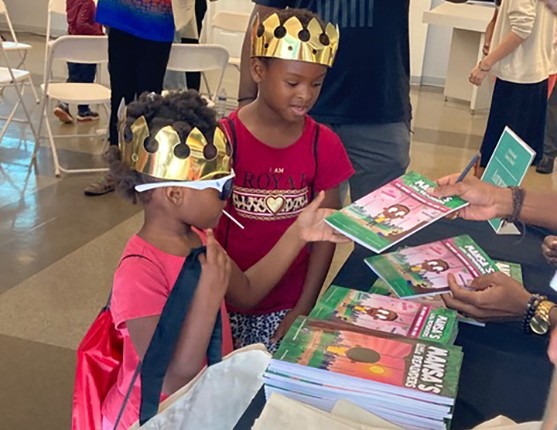
At a talk by Antwan Williams, St. Petersburg author of Mansa’s Little Reminders: Scratching the Surface of Financial Literacy, parents got tips on how to teach their children financial literacy.

Headliners at the St. Pete Reads! Lit Fest included Antwan Williams, author of Mansa’s Little Reminders: Scratching the Surface of Financial Literacy
Getting free books at the st. Pete Reads! Lit Fest – Mansa’s Little Reminders by Antwan Williams

At a talk by Greg Neri, the Tampa-based author of Concrete Cowboy (which became the basis of a Netflix movie starring Idris Elba) and its sequel Polo Cowboy, they learned never to give up on a kid, even one who is acting out in middle school.

Every child could choose a book

Two panel discussions, both entitled “Everything You Wanted to Know About Childhood Literacy But Were Afraid to Ask,” reinforced the idea that it takes a village to get a child reading. The first was aimed at parents and caregivers with preschoolers. The second was for those in charge of middle schoolers.

Unisha Bullard, at left, multitasking, feeding her newborn while moderated the panel discussion Everything You Ever Wanted to Know About Childhood Literacy But Were Afraid To Ask for parents of preschoolers. She is with fellow panelist Tabree Fort, owner of the Learning Fort.

The first was moderated by Unisha Bullard, a teacher at Mt. Moriah Christian Academy in South St. Pete for grades 6-8 and a new mother. She masterfully guided the discussion with her newborn on her lap.

Marcus A. Brooks, executive director of the Center for Health Equity, and Ronesha Roberson, founder of Speechology, participating in the panel, Everything You Ever Wanted to Know About Childhood Literacy But Were Afraid to Ask for parents of preschoolers.

The other panelists discussing how to get younger children interested in reading were Ronesha Roberson, a speech pathologist and founder of Speechology serving children up to five and their parents; Marcus A. Brooks, executive director of the Center for Health Equity and self-described “Black husband, Black father (of two sons), Black Man,” and Tabree Fort, “owner, lead teacher, maintenance person and chef of my own small licensed home pre-school called The Learning Fort,” for kids from 3-5.

From left: Greg Neri, Coretta Scott King honor-winning author of teen fiction; Sapheria Emani, a first year teacher at Johns Hopkins Middle School; Dr. Maurie Lung, co-founder of Life Adventures for All, and moderator Marcus A. Brooks at the panel Everything You Ever Wanted to Know About Childhood Literacy But Were Afraid To Ask, for parents of middle schoolers.

Brooks moderated the second Everything You Wanted to Know panel, which gave out great advice on how to encourage reluctant middle schoolers to read. The other panelists were Sapheria Emani, a first time teacher (8th grade) at Johns Hopkins Middle School, and Dr. Maurie Lung, co-founder of Life Adventures for All, a mental health community organization and parent of 7-year-old triplets and a nine year old.


Greg Neri, a Coretta Scott King honor-winning author who is based in Tampa

Neri told a touching story both during the panel discussion and at his own individual talk about how one of his books — Chess Rumble, a graphic novella in free verse about a troubled boy whose life was turned around by a game of chess  — changed the life of a troubled kid in Tampa who is now getting his PhD. (Read the story here in the School Library Journal’s “The Author, the Poet, and the Librarian”).

“You never know what one book can do,”  Neri says.

Wednesday, October 26, 2022

Baseball Stories: Out of the Mouth of Babe and Other Gods From the Sport's Golden Age

By Margo Hammond

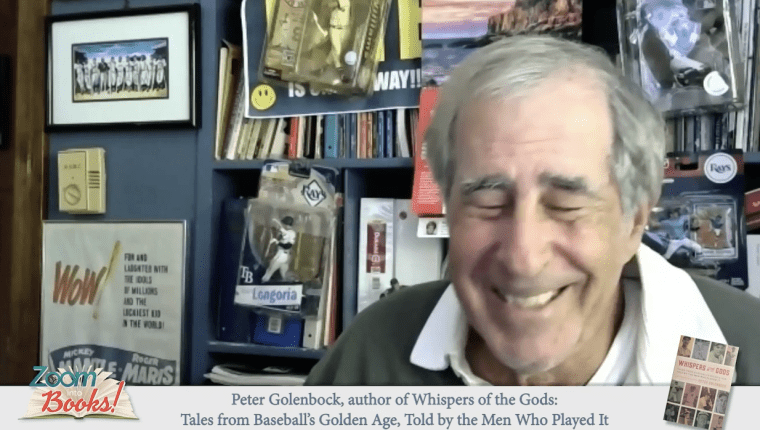
Here's a book of baseball stories that take us back to the so-called Golden Age of the sport, written by someone who insists that there is no such thing. "Every day of every year is the Golden Age of baseball," says Peter Golenbock, St. Petersburg's most famous baseball writer. I may not be as big a baseball fan as Golenbock (his beloved Rays didn't make it to the World Series this year -- Game One between the Phillies and the Astros is on Friday), but I agree with him on one thing: Of all the sports, baseball has the best stories.

 . .

Inside-baseball (adj.) American slang, referring to the minutiae and detailed inner workings of a system that are only of interest to experts, insiders and aficionados. First used in 1890 to describe a particular way the game of baseball was played – one that involved singles, walks, bunts and stolen bases rather than power hitting.

Whispers of the Gods by St. Petersburg’s most famous baseball writer is not just an inside-baseball baseball book.

Sure, the book includes some “minutiae savored by the cognoscenti, delicious details, nuances discussed and dissected by aficionados,” the definition of inside baseball offered up by William Safire, who for years wrote a New York Times column about the “inside baseball” of language. But Whispers of the Gods by Peter Golenbock doesn’t just appeal to the expert steeped in the stats and history of the sport. Like the best of baseball books, it offers up stories and baseball lore that even a casual baseball fan can’t help but find compelling.

The material comes from old cassettes of interviews Golenbock did for his long-list of published books – eight New York Times bestsellers, including Dynasty, a history of the Yankees from 1949 to 1964 and oral histories of the Brooklyn Dodgers, Boston Red Sox, Chicago Cubs, St. Louis Cardinals and Browns, and New York Mets.
. . .

. . .
For each book Golenbock interviewed dozens of players, executives and journalists, from Superstar Stan Musial who played his whole career with the Cardinals to Jim Brosnan known as The Professor, who pitched in the major leagues from 1954 to 1963 for the Chicago Cubs, St. Louis Cardinals, Cincinnati Reds, and the Chicago White Sox.

Many of the details, facts, anecdotes and histories from those cassettes of course ended up in the body of his books. But some of the stuff remained in the tapes unused. Now some of the juiciest tidbits left behind have been revived here – tales of club rivalries and unresolved grudges, unexpected friendships, conflicting memories about what really happen on the field when Jackie Robinson desegregated baseball and, of course, money. In nearly every interview, the players bring up money — how much (or more often how little) they were paid in those early years of baseball.

Tales, as the book’s subtitle puts it, from Baseball’s Golden Age, Told by the Men Who Played It.

Red Sox superstar Ted Williams, at 89, makes an impassioned plea for the rehabilitation of disgraced baseball legend Shoeless Joe Jackson who, along with seven other Chicago White Sox players, was accused of throwing the 1919 World Series. Gene Conley reflects on how he managed to play for both Major League Baseball and the National Basketball Association simultaneously. Pitcher Jim Bouton opens up about how hurt he was that his own book, Ball Four, an honest look at behind-the-scenes in baseball, earned him lifelong shunning from Mickey Mantle and the Yankees. Roger Maris puzzles over the resentment he stirred up for breaking Babe Ruth’s record 60 home runs in a season.
. . .

Babe Ruth. National Baseball Hall of Fame. From “Whispers of the Gods” by Peter Golenbock, published by Rowman & Littlefield.

. . .
And speaking of Babe Ruth, Ed Froleich serves up some of the book’s best stories when he talks about the Yankee great. A trainer for the Yankees when Ruth was on the team, Froleich reports, for example, that when he told the Babe that some people in Chicago were still repeating the legend that he pointed to center field before hitting his famous home run in the 1932 World Series, Babe Ruth debunked the canard – “‘You tell those people for Baby’—he always called himself Baby —‘that Baby says they’re full of crap right up to their eyes. I may be dumb, but I’m not that dumb. I’m going to point to the center field bleachers with a barracuda like Root out there? The next pitch they’d be picking out of my ear with a pair of tweezers.’”

Froleich wryly comments on Ruth’s unique stance on the field. “Have you seen films of Babe hitting?” he asks Golenbock. “He had his ass to the pitcher, and he would only be looking at him with the corner of his right eye. This is a direct contradiction to the theory that you see something better if you look at it with both eyes. If I were ever going to coach a hitter, I would tell him to have both eyes on the pitcher. Stan Musial did that. Not Ruth. And Babe had a dip in his swing, a little hitch, and if you advised a batter, you’d tell him he could never hit with a hitch. And for most people, this is true. But such advice is for the ordinary person. When you’re Babe Ruth, the ordinary doesn’t apply.”
. . .

. . .
Some of the most contradictory memories in the book are about how ballplayers reacted when the Brooklyn Dodgers signed up Robinson as the first African American to play in the Major Leagues. Cardinal shortstop Marty Marion vigorously denies that Cardinal players threatened to strike if they had to play Robinson. “Striking?” he says. “We thought that was ridiculous. Sure, we didn’t like Jackie Robinson. We didn’t like anybody on the Dodgers. But that had nothing to do with Jackie Robinson being Black.”

Pitcher Kirby Higbe, on the other hand, freely admits that he was one of the Southerners on the Dodger team who went to general manager Branch Rickey to plead with him not to add Robinson to the roster. Higbe contends, however, that that was not why he was traded by Rickey a month into the ’47 season along with Dixie Walker and Dixie Howell, the other Southerners who opposed Robinson’s signing.

Rex Barney, a player from Omaha, Nebraska who pitched for the Brooklyn Dodgers when Robinson was on the team, recalls just how difficult a time Robinson had that first year. “That first season that Jackie was with us, we went to Pittsburgh, Chicago, St. Louis, the first trip around the league with Jackie, and a lot of players on other teams wanted to strike. They didn’t even want to go on the field. In those days, 90 percent of the baseball players came from the South. Now they come from the West, California and Arizona. But there were a lot of redneck people. They would look at you and say, “My ancestors, my kinfolk, they’d kill me if they found out I was playing with a Black man.” And they didn’t say ‘Black man,’ but it’s the only kind of talk I can use. That’s the way they were. It was ridiculous.”
. . .

. . .
Another fascinating interview was with Monte Irvin, the man that could have been the first Black player in the Major Leagues, but, says Golenbock, Irvin turned the Dodgers down. “He felt so angry at his racist treatment by white superior officers in the army that he told the manager he wasn’t psychologically prepared to take on the abuse that Robinson would absorb,” Golenbock writes. Irvin finally ended up signing with the New York Giants in 1949. “This was two years after Jackie,” says Irvin. “They had gotten used to seeing an African American on the field. It wasn’t a picnic. We heard the names. But we didn’t have it as tough as he did.”

Golenbock includes excerpts from his 1981 interview with pitcher Roy Campanella for his book Bums on the Brooklyn Dodgers. Campanella was the second African American to break the color barrier in Major League Baseball, joining the Dodgers in 1948. Just before the Dodgers moved to Los Angeles ten years later, his career was cut short by a car accident that left him in a wheelchair for the rest of his life. Golenbock describes him as “one of the kindest, sweetest men.”
. . .

. . .
There aren’t many witness still around from baseball’s Golden Age era, usually considered to be from about 1920 to 1960. “All of the baseball cards are dying,” sports and political commentator Keith Olbermann said when Hank Aaron died in 2021. (Olbermann is quoted by John Thorn in his introduction to Golenbock’s book). All of the 16 players Golenbock includes in Whispers of the Gods have passed on.

But in Whispers of the Gods, their stories come alive.

“Baseball is a backward-looking institution,” writes Thorn who has the impressive title of the Official Baseball Historian for Major League Baseball. “It pleases us to think that giants once strode the earth and their like will not be seen again. This is baloney of course. But serve it up between two slices of bread, with a shmeer of nostalgia, and count me in.”
. . .

Three Questions for Peter Golenbock

. . .
Traditionally, the Golden Age of Baseball is said to span between 1920-1960. What have been the Golden years for you personally?

Golenbock: For me there is no Golden Age of baseball. Every day of every year is the Golden Age of baseball.

I was in awe when I went to Yankee Stadium to watch the Yankees of Mantle and then Thurmon Munson and then Derek Jeter. I am in awe now when I go to the Trop and watch the Rays, one of the finest defensive teams in baseball today. Every era has stars and excitement and gold.

Which current player do you think would make the most interesting interview subject?

Golenbock: Many players would make for interesting interviews. I would love to talk to Albert Pujols, who is about to hit his 700th home run, joining Barry Bonds, Hark Aaron and Alex Rodriguez in that exclusive club. Aaron Judge would also be interesting, as he attempts to break Roger Maris’s record for home runs in one season hit by an American Leaguer.

There are many interesting Latin players today, but my Spanish isn’t very good, and understanding their answers would be hard. When I interviewed Sandy Amoros, the left fielder for the Brooklyn Dodgers, he understood English but spoke only Spanish. He spoke to me in Spanish, and I brought the tape to my mother, a high school Spanish and French teacher, and she translated the tape for me.


Since 2002 baseball has celebrated Roberto Clemente Day on September 15 to honor the Puerto Rican superstar who died in a plane crash while attempting to deliver supplies to earthquake victims in Nicaragua. This year, the Rays made history with an all-Latino starting lineup on September 15, which was also the first day of Hispanic Heritage Month. Were you surprised?

Golenbock: On Roberto Clemente Day last week, every member of the Rays starting lineup was Hispanic, which was a first. Was I surprised? When I saw that Ji Man Choi, Yu Chang and Taylor Walls weren’t in the lineup, I started to do the math, and I saw that every player came from Puerto Rico, Mexico, Panama, Venezuela or the Dominican Republic.

I thought back to when Major League teams wouldn’t take players because of the color of their skin, and it made me smile.


This piece originally was posted in Arts Coast Magazine, the online journal of Creative Pinellas, on September 22, 2022.