Sunday, July 22, 2012

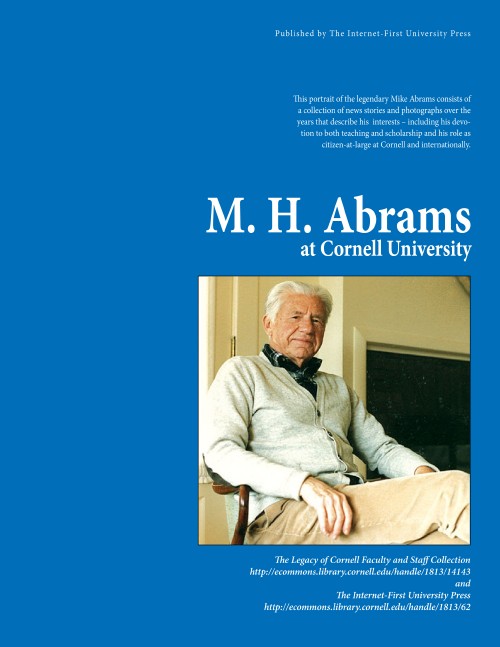
At 100, M.H. Abrams Continues to Bloom

    M.H. Abrams is not a late bloomer. He published his first book at age 22 and has published every decade of his life since. His latest is a book of essays, slated to come out from Norton in the fall, called "The Fourth Dimensions of a Poet." Today he was scheduled to give a lecture on the subject at Cornell University where he began teaching in 1945.

    No, Abrams is not a late bloomer. He's is a non-stop bloomer.  Tomorrow is his birthday.  He will be 100 years old.

    Yes, at 100, Abrams is still lecturing and writing and publishing and pursuing a life-long love of literature.

     If you want to see what it looks like to bloom into your nineties, continuing to pursue your life-long passion, treat yourself to this video of Abrams talking about reading poetry:  http://www.cornell.edu/video/?videoID=1088

   
      "I go back far enough so that when I was a college student I heard T.S. Eliot, Ezra Pound and e e cummings read their poems. Each read differently but all read well. I heard Robert Frost talk his poems to great effect. And I heard Dylan Thomas recite poems in a Welsh bardic chant to an equal or greater effect," Abrams reminded his audience last fall.

      If you went to college, and especially if you were a lit major, you most likely bought this work of Abrams: The Norton Anthology of English Literature. Abrams was the founding editor of that mainstay of English Departments on college campuses across the country. Many of us still can't part with our dog-eared copies. The sight of my husband's battered Volume I hardback on his bookshelf was one of the reasons I fell in love with him.

     Abrams also wrote two major works of contemporary literary criticism: "The Mirror and the Lamp: Romantic Theory and the Critical Tradition" (1953) and "Natural Supernaturalism" (1973). Among his students at Cornell were Harold Bloom and Thomas Pynchon.

      But this is no stuffy professor.

      When Danielle Winterton of the Ithaca Times, recently asked Abrams who we should be reading now, there wasn't a dead white man in sight. Sounding more like a hip, up-to-date literary critic than a professor emeritus, Abrams recommended the novels of Gillian Flynn. Flynn's latest is the popular thriller "Gone Girl."

     Abrams' life is the "model of the intellectual journey in which every stage breaks new ground,"  Roger Gilbert, the chair of Cornell's English Department, told the Ithaca Times. "It is incredibly moving and inspiring to see how he has insisted on remaining engaged, thinking new thoughts, and being aware of what is happening in the world of literary studies." 

      Abrams was never much for resting on his laurels -- or resting at all. He continued to renew and update his anthology, throwing out old names and adding new ones. Each new edition -- it's now on its 10th -- has been "a collaboration between editors, users, teachers, and students,"Abrams told the Ithaca Times. "That's the way to keep the thing vital and alive and current." The formula is working: more than 50 years after Adams launched it, the anthology is thriving.

      Abrams obviously has kept himself vital, alive and current as well, although he doesn't see reaching the age of 100 as much of an achievement.

     "It's nothing I worked on, I assure you," he told Winterton. "I don't know why people think you somehow deserve it; you don't deserve it or not deserve it; it happens to you."

     Born in 1912, Abrams never let anything -- not even the Great Depression -- prevent him from following his dreams of becoming a literary critic, a professor, a thinker.

     "Abrams has often said he choose English as a field of study because there weren't any jobs in any field at the time, and he figured he might has well starve doing something that he liked instead of starving while doing something he disliked," writes Winterton. 

      Today, in celebration of its centenarian scholar, Cornell also scheduled an "Open Mike for Mike," to let friends, students, colleagues and admirers pay tribute to Abrams for his birthday. Among those who sent in tributes and birthday wishes were Bloom and poet Robert Pinsky.

     Fellow literary critic E.D. Hirsch, Jr. posted what he called one of his favorite Abrams-ism: Good criticism requires "a keen eye for the obvious."


Friday, June 15, 2012

THE TIME I TRIED TO EDIT RAY BRADBURY


     When a famous author dies, readers write fondly about the first time they met the icon -- in print, that is -- and let us know which book or quote is their favorite. Friends of the dearly departed, who knew the writer beyond his or her written work, pen more personal tributes. Then there are us lesser lights who recall our brief brush with greatness -- and cringe at the memory.

       Like the time I tried to edit Ray Bradbury.

       My close encounter with Bradbury was a disaster. And as I look back now, a pretty predictable disaster. There I was a lowly book editor at the St. Petersburg Times asking a sci-fi megastar to do a piece on assignment, an article imagining how the Super Bowl might evolve in 100 years. What chutzpah!

      At first, my charming naivety paid off. Bradbury agreed to do the work  -- albeit for an exorbitant price. But charm and chutzpah ultimately couldn't save me from the inherent folly of the enterprise. When it was all over, Bradbury got to bank a hefty kill fee and I deposited three important conclusions:

       1) Imaginative writing should not be commissioned.
       2) Science fiction/fantasy writers are not overly fond of narrative structure.
       3) All writers need editors except the famous ones who won't.

       Like a lot of bad ideas, this idea sounded good at the time. It was just before the 35th Super Bowl in January 2001, the first Super Bowl of the 20th century, and it was to be held in Tampa. The newspaper's sports editor thought it would be cool to have a science fiction writer imagine what Super Bowl 2101 would look like.
     
       I could have found a local sci fi writer who would have been thrilled to take a stab it. But, no. I had to think BIG. I had to go for the supernova of sci fi/fantasy: Ray Bradbury.

      I should have been wary when Bradbury asked for so much money. But, hey, how can you put a price on greatness? What a coup a Bradbury original would be! People would be talking about this piece for decades -- maybe even until 2101.

     Then Bradbury's article arrived.

      He had entitled it Sporticus 2101. He imagined the greatest Super Bowl game in all history was held in a super arena that had been conceived in the year 2000 by the architectural consultant/designer Ray Bradbury. He imagined the humongous stadium was ringed with endless shops where athletes of every sport imaginable -- even jai alai -- could find the world's best sports equipment. He imagined that the first Superbowl of the 22nd century was witnessed by two billion people who paid one hundred billion dollars to see the Quicksilver Lites beat the Gigantic Bisons.

     All the ingredients were there. The only problem was, they were not there in any readable order. The piece was chaotic, with imaginative ideas popping out all over the place. It was nearly impossible to follow as Bradbury offered up sentence fragments and inexplicable twists and turns.

     The gigantic stadium and its environs had become the center of all sports in the U.S.: surfing, ski jumping, even kite-flying and fights between wild buffalos and stark mad elephants. The revenues from the Super Bowl were given to needy countries to build schools. Stadiums like Sporticus were built all over the world and eventually wiped out wars. The U.S. president once had been a star quarterback. Future football leagues had three weight divisions.

       Huh? What's he talking about? the sports editor asked me. Don't worry, I told him. It'll be fine.

       I'll just do some editing.

        I moved sentences around. I completed others. I tried to fill in some holes in Bradbury's logic. I smoothed over the bumps. When some of the sentences still remained unclear to me, I attached notes, asking Bradbury to clarify and/or to flush out certain sections.

       Okay, I gutted the piece. I tried to tame Bradbury's exuberance and create a more coherent narrative. I trimmed back excess and shaped the story into something less confusing albeit more prosaic. Then I emailed the edited version to Bradbury with a note about how it was such an honor to work with him. I tried to make it clear that this was just the beginning of the editing process. None of my changes were writ in stone. I imagined myself the Maxwell Perkins to his Ernest Hemingway.

      Bradbury was quick to respond: We had to print exactly what he wrote or nothing at all.

      We chose nothing. We sent him a kill fee of thousands of dollars. It seemed fair. He was, after all, Ray Bradbury.

      Over the years, I have mulled over and over this hapless story of my Distant Sighting of Ray Bradbury. At times, when I'm feeling pessimistic, I am convinced that he knew all along that we would never print his mishmash of a piece and that he just took the assignment for the kill fee. I imagine him laughing at our attempt to make the muddled article work for a newspaper audience. At other more self-deprecating times, I tell myself that it was all my fault. I was awfully cheeky to try to edit such an icon and I deserved to be turned flat down. I imagine that Bradbury was sad not to see his phantasmagoric imaginings of Super Bowl 2101 in print.

      Then I remember: I am talking about Ray Bradbury, a writer who authored hundreds of published short stories, close to 50 books and numerous poems, essays, operas, plays, teleplays and screenplays during a career that lasted more than 70 years. We clearly had needed him far more than he had needed us. Why should he have bothered to deal with an obscure book editor?

       Bradbury already had legions of adoring fans who wouldn't have cared a whit that his piece read like a first draft. Sci fi lovers are notoriously tolerant of works that show their seams in the service of an imaginative idea. Why else would fans of Doctor Who have put up with those cheesy props and fake planets for so long?

     In her tribute to Bradbury on her blog Ramblings, my niece Sonja  explained why she was willing to accept the implausibility of matters both large and small in her reading and later re-reading of a Bradbury's short story entitled "All Summer in a Day."

    She was in the sixth grade when the teacher had the class read that story of an Earth girl who was tormented by her classmates on Venus. It was Sonja's first introduction to Bradbury. She was entranced with the idea of a world where the sun only came out for two hours every seven years. Then as an adult and a teacher herself, she assigned "All Summer in a Day" to her students. On re-reading the tale, Sonja noticed a few off-kilter details she had overlooked as a child. But so what? What's a plot hole or two matter in a story that has haunted you for years? Bradbury already had her believing that a girl could travel from Earth to Venus and that a planet could sustain life without sunshine. Having to swallow more minor imaginative stretchings -- like why would the teacher have left her students alone and why when they went out to see the sun wouldn't she have noticed a pupil was missing -- was no biggie in the service of making a point about bullying in such a unique way. "'All Summer in a Day' was an excellent way to open a deeper discussion with students about tolerating differences among classmates," my niece wrote, opting for originality over believability.

       Of course, Bradbury's forecast of a super Super Bowl stadium wasn't all that damn original. Decades earlier -- in Esquire in 1973 -- William Harrison had already conjured up a future sports arena that was awesome to behold. Rollerball, anyone? But Bradbury's imaginings of the first Super Bowl of the 21st century had come in a vintage Bradbury package that his more devoted fans might have appreciated. As far removed from the who-what-when-where-why-how inverted pyramid structure of journalism as you could get, Sporticus 2101 was a jumbled juxtaposition of crazy flights of fancy, loopy predictions and prosaic declarations coming at you in a feverish, confusing flood of Bradbury words.

       Every last unedited one of them.


Friday, June 8, 2012

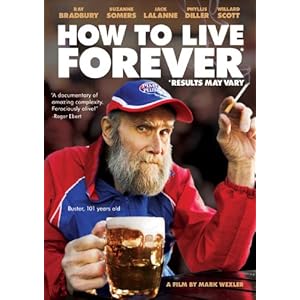
HOW TO LIVE FOREVER (RESULTS MAY VARY)

Several years ago I got a call from Mark Wexler. We used to refer to a call like that as a blast from the past. I hadn't talked with Mark since we both lived in New York in the Eighties. Back then, he was a photographer. Since then he had become a documentary filmmaker. He had already completed two films: "Me and My Matchmaker" and "Tell Them Who You Are." The latter is about his famous father, cinematographer Haskell Wexler. I had never known he was that Wexler's son.


Mark invited me to meet him at the Sarasota Film Festival to see his latest documentary, "How to Live Forever."  It's all about the fears (and joys) of growing old, which dovetails nicely with my creative late bloomer obsessions.


How to Live ForeverThe film is told in a wry and really engaging way. You don't expect to laugh when you go to a film about aging, but this one's a riot. Its cast of characters include the world's oldest woman, Phyllis Diller, a 94-year-old heart surgeon, Jack Lalane, a 92-year-old Japanese who dives for fish, Suzanne Somers who is touting hormones, a coffin maker and the people of Okinawa who are the longest living on earth.


After seeing the film, I told Mark, "Everyone should see this film -- young and old." Now everyone can. It's finally available as a DVD on Amazon and iTunes. The DVD has 30 minutes of bonus material that I probably didn't see when I was down in Sarasota. Now I'll have to buy the DVD, too. Pretty clever of you, Mark.


The release of the "How to Live Forever" DVD coincidentally comes in the same week as the death of Ray Bradbury who is one of the subjects in Mark's film. Of course, Bradbury, who was 91 when he died on June 5, long ago found a way to live forever: through his books.


In the film, Bradbury, who was then 87, points out that he has written many books about old people, referring in particular to "Dandelion Wine," published in 1957. Then he talks about the sequel he just has written to that book which he says is again about the relationship between younger and older folk. This time though, he says, it's a conversation between his 13-year-old self and his older self. He compares the confrontation of these two Bradburys to Lee and Grant at Appomattox. Each has to learn to accept the other, he says. He doesn't name the book, but it turned out to be the last novel he released in his lifetime, published in 2006. It's called "Farewell Summer."